
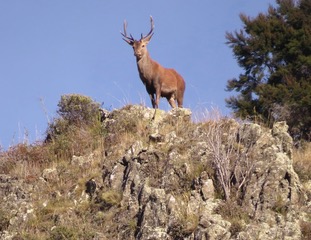
A Department of Conservation paper ”Ruahine Forest Park Adaptive Wild Deer Management Plan 2025-30” has been criticised by the Council of Outdoor Recreation Associations as “archaic in its thinking” and ”ignorant of ecological facts”.
Deerstalking author and former Council of Outdoor Recreation Associations chairman Tony Orman said the paper provoked recollection of an American zoology professor who in the late 1950s said New Zealand government departments culture was tainted by an “anti-exotic wild animal phobia” .
The Plan’s executive summary said “long-term monitoring and community experience show that deer are a major contributor to declining forest health and biodiversity in Ruahine Forest Park.”
But Tony Orman said this was at odds with hydrologist-botanist the late Dr Patrick Grant’s scientific research which extensively over years examined the Ruahine Range’s vegetation.
Dr Grant ’s research stemmed from reading early European missionary explorer William Colenso’s diary which told of severe forest damage of extensive land slips and stream beds choked with shingle and dead trees in the 1840s, 50 years before deer were established.
Climatic Cycles
Dr Grant concluded that climate cycles of severe droughts stormy periods were the principal cause, with wild animals having had comparatively minimal detrimental effect. He identified various destructive cyclonic periods going back to 1530.
Tony Orman said the department’s use of 20 metre square forest exclosures to compare vegetation inside and outside, was flawed.
“The exclosures would have shown the same effect in moa times,” he said. “Several species of moas ranged from lowland forest giant birds to a smaller sub-species inhabiting snow grass, browsing foliage. The effect of either deer or moa browsing is to alter the composition of the forest with a decrease in palatable species and an increase in unpalatable species. Exclosure plots prove nothing relative to natural browsing patterns and the ecological evolvement of the vegetation.”
Sixty Million Years
Scientific research published in the New Zealand Journal of Ecology and elsewhere found that moas, until hunted to extinction by early human colonisers, had browsed New Zealand’s vegetation for 60 million years so that vegetation had also evolved defensive mechanisms by way of thorns, branch and leaf structure, bitterness and even toxins.
In addition the Plan ignores the geological instability with a major fault line running along the Ruahine Ranges’ eastern flank.
The department’s Ruahine Range Plan is based on an entirely false premise, embedded in anti-wild animal dogma, he added. This is however, unsurprising as it is a a trait of bureaucrats to create a problem, even if imaginary, as a means of survival of salaried jobs.
END

DoC’s Ruahine Animal Management Plan is a mish-mash of anti-deer rhetoric and unscientific supposition. It doesn’t even attempt to conform to the established methodology of animal management plans i.e. It does not specify what the conservation “values” are which need protecting, nor does it specify any measurable deer density which might be consistent with that protection. Why is the taxpayer funding such incompetence?
Part of the latest burst of anti-deer dogma comes from the upsurge in numbers in land that was retired from farming to grow pine trees without allowing for adequate culling of the deer that invade these areas. The answer is surely to employ more cullers.
Apart from the difficulty of obtaining lawful access to many blocks, often now foreign owned, there is always the fear that the deer meat may be contaminated with 1080 because of the madly irresponsible broadcasting of this foul poison by DOC and AHB.
There is no doubt deer are a wild, introduced species .. that, like all wild, introduced species, require population management.
Just like wilding pines require control work.
There is no doubt deer can damage forests, if their numbers become locally excessive.
Just like agricultural intensification can damage river flows, underground aquifers, and nitrate levels.
Conversely, there is no doubt we will never eradicate wilding pines, nor eliminate agriculture.
Nor deer.
Forests can be completely destroyed by fire.
They recover.
Māori burned vast tracts of forest, in their pursuit of Moa.
We’ve cleared millions of hectares of forest and bush, for agricultural development.
Even at their highest levels .. deer do not do the material damage that is caused by forestry felling. They don’t cause slash that turns up in all of the riverbeds .. and wipe out all of the bridges .. every time there is a major flood.
The myth that ungulates cause significant erosion .. was debunked decades ago.
Serious rain and snows causes erosion that eclipses that of any other cause (except for that which may be caused by the more direct actions of humankind .. and that generally in more lowland areas).
There is no need for people .. including state sector employees working within our Department of Conservation .. to be reinventing any wheels.
Maybe there are too many people within DOC with too much time on their hands, looking to justify their existence?
The monologue gets really boring, after a while.
I’m sure I’m not the only person who resents paying taxes to keep funding it …
If DOC put half as much effort into facilitating improved efficiency and effectiveness of Recreational Hunting on Public Land (including Public Access) .. which would have a payback in perpetuity (given Recreational Hunting comes at no operational
cost to taxpayers and ratepayers) .. as they do into writing whinging drivel, wishing that things were different than they are .. we would all be better off.
The comment “There is no doubt deer can damage forests, if their numbers become locally excessive,” doesn’t happen.
Deer like moa have food preferences, i.e. palatable species e.g. broadleaf.
As deer numbers increase, palatable species are less, unpalatable increase.
The species composition alters to less palatable species, more unpalatable.
The sad thing is too many deer results in lack of food, poor animals and increased deaths.
The Lake Monk study by Thane Riney showed animals reach a peak, Nature steps in and the population declines to a low level to under the carrying capacity of the habitat. It’s the ‘bell curve’ graph.
Of course, it’s in the interests of managing deer to ensure animals are harvested to keep under the carrying capacity. Hunters want quality, healthy deer. And if deer could talk, they’d say so too!
DoC just doesn’t understanbd simple things.