New national forestry rules have come into force, with the stated aim of improving consistency and reducing compliance costs across the sector. The changes affect how activities such as harvesting, erosion control, and slash management are regulated. On the surface, the reforms focus on efficiency and clarity. The underlying question is whether that consistency also alters how risk is managed.
What changes are structural. Councils now have reduced ability to impose stricter local rules, risk-based assessments replace some prescriptive requirements, and planning obligations for certain activities have been simplified. Taken together, these shifts move decision-making away from local oversight toward a more centralised framework, with increased reliance on industry-led assessments.
This alters how risk is distributed. Forestry activity in steep or erosion-prone terrain can generate downstream impacts, particularly during severe weather. Where local controls are constrained and standards are generalised, the ability to respond to site-specific conditions is reduced. That may improve certainty for operators, but it can also weaken safeguards where risk does not fit neatly within defined categories.
This pattern is consistent with broader changes already underway. Fast-track consenting, planning constraints on councils, and centralised standards all point toward a system that prioritises speed and uniformity. Individually, these changes may be justified. Taken together, they reshape how environmental risk is assessed, managed, and ultimately borne.
Forestry is a significant contributor to the economy, but it operates within catchments that support communities, infrastructure, and ecosystems. Where activity generates downstream effects, responsibility for those effects must remain clear. Systems that rely heavily on standardisation and self-assessment require strong oversight to maintain confidence in outcomes.
This is not about whether forestry should operate, or whether rules should be consistent. It is about whether the framework managing that activity maintains sufficient alignment between those who create risk and those who experience it. The issue is not consistency itself, but whether it comes at the cost of resilience and accountability.
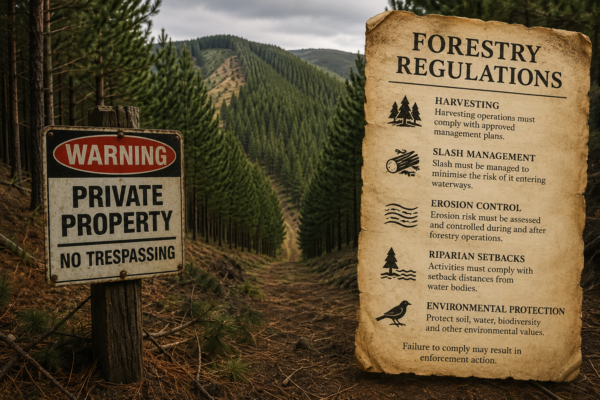
So local authorities are to be stripped of the authority to intervene in local oversight of things that affect locals? Slash is for many a major issue – just how many times do we see headlines of townships hit by massive floods and inundation of forestry byproducts?
And yet the forestry owners who benefit enormously are not held accountable for their waste – why not indeed?
Forestry’s impact is mainly negative. Pines use great volumes of water thereby depleting streams,. sedimentation from clear felling, slash on beaches and one that slips under the radar, damage to country roads wrecking sealing, corrugating shingle roads, traffic hazard on narrow country roads etc.,
“Pothole Pete” you missed out mentioning that forestry results in decline to rural communities, falling school rolls mean schools close for the few left. This has a huge impact.