A recent interview has questioned whether the economic model that has driven growth for the past two centuries is still fit for purpose. The argument is not that development has failed, but that the conditions which once allowed expansion without immediate consequence have changed. Growth has historically improved living standards, but it has also relied on the assumption that environmental limits were distant or manageable.
What changes now is the scale at which those limits are encountered. Natural systems that once absorbed pressure are showing signs of constraint. Fisheries, freshwater, biodiversity, and coastal environments are no longer operating within the margins that previously allowed continual expansion. Taken together, this shifts the relationship between economic activity and environmental capacity.
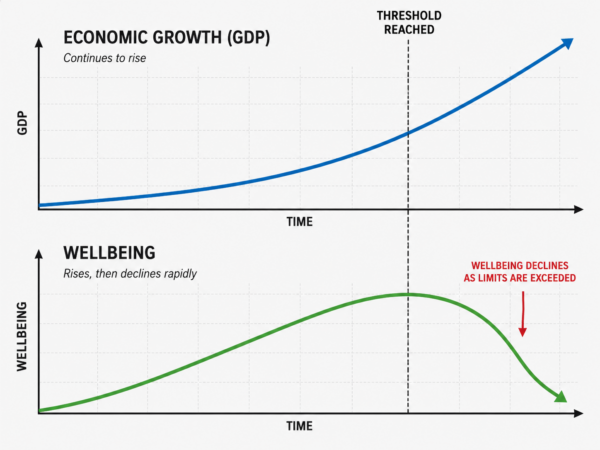
Gross Domestic Product remains the dominant measure of success, but it does not account for depletion or degradation of natural systems. Activity that increases output can still reduce long-term resilience. That creates a disconnect between what is measured and what is sustained. Growth may continue in numerical terms while the underlying systems that support it weaken.
This tension is not theoretical. It is visible in everyday examples, from declining water quality to pressure on access to natural spaces. Economic activity may increase, but the quality of the environment in which that activity occurs can decline at the same time. When that happens, the measure and the outcome begin to diverge.
There is no single alternative metric that resolves this completely. However, recognising limits changes how success is defined. Systems that operate within ecological boundaries require balance rather than continual expansion. Efficiency, durability, and stewardship begin to carry more weight than volume alone.
This is not about rejecting economic growth. It is about understanding what it measures and what it does not. The issue is not whether economies expand, but whether the systems that sustain them remain intact over time.
I seem to recollect that CORANZ and contributor Tony Orman have argued long and hard against GDP. This article from Tony about a year ago https://coranz.org.nz/gdp-like-a-dog-chasing-its-tail/
We need a wellbeing indicator rather than chasing the false goddess of GDP which overwhelmingly demands increases in immigration, infrastructure, housing and the resulting environmental impacts destroying Godzone brick by brick
Where exactly do we find a wellbeing chart that hasn’t been corrupted. Can believe anything that comes out of a politicians mouth,
GDP under the neo-liberal culture has failed. People are not better off economically in fact its degraded. Countries are bankrupt and people are more stressed and less happy.
It shows in society which has become unstable and well yes, mentally sick, corrupted and greedy.
An increasing number of economists are questioning the growth for growth’s sake ideology as represented by GDP. “Doughnut Economics: Seven Ways to Think Like a 21st-Century Economist” is a 2017 non-fiction book by Oxford economist Kate Raworth. The book elaborates on her concept of doughnut economics, first developed in her 2012 paper, A Safe and Just Space for Humanity.
All politicians and as many as possible should read it.