
A recent controversy surrounding a children’s rockpool exploration event in Auckland should give us pause for thought. What began as a supervised educational outing ended with organisers and families facing online abuse after some observers mistakenly believed the group was harvesting marine life from local rockpools.
The reality was very different.
The event, organised by the Sir Peter Blake Marine Education and Recreation Centre (MERC), encouraged children to temporarily observe marine creatures before carefully returning every animal to the habitat from which it came. Along the way they learned about the remarkable species that live between the tides, why these fragile ecosystems matter, and why responsible care of our marine environment is so important.
That is not exploitation. It is education.
Many of today’s recreational fishers, divers, marine scientists and conservationists began their journey exactly the same way. They turned over rocks, discovered tiny crabs, watched anemones close their tentacles, examined sea stars, and marvelled at the diversity of life hidden in a seemingly ordinary rockpool. Those childhood moments created a lifelong respect for the sea.
Conservation rarely begins in a classroom. More often, it begins with curiosity.
None of this diminishes the very real concerns surrounding the depletion of rockpool life in some parts of Auckland. Recreational harvesting rules are currently under review, and communities have every right to be concerned about protecting vulnerable coastal ecosystems. Illegal harvesting, over-collection and habitat damage deserve attention and, where necessary, firm enforcement.
But there is an important distinction between education and exploitation.
A supervised group of children carefully observing marine life before returning it to its natural home is fundamentally different from people removing shellfish or other species for consumption. One seeks to understand nature. The other removes part of it.
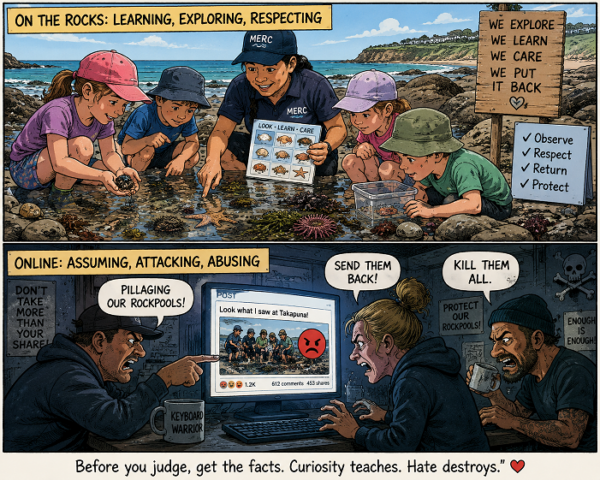
The unfortunate misunderstanding also highlights another lesson. Before jumping to conclusions, we should first seek the facts. The organisers involved were promoting exactly the values that conservation depends upon: respect, care, curiosity and stewardship. Those values deserve encouragement, not condemnation.
As outdoor recreationists, we understand that meaningful conservation comes from developing a personal connection with the natural world. Children who have held a crab, watched a shrimp dart through a rockpool, or gently returned a sea snail to the exact rock where they found it are far more likely to become adults who value healthy oceans and support their protection.
Future conservationists will not emerge simply because rules tell them what they cannot do. They will emerge because someone first gave them the opportunity to discover why these places matter.
New Zealand’s remarkable coastline is one of our greatest natural classrooms. Used responsibly, it teaches lessons that no textbook can ever fully replace.
Conservation begins not with prohibition, but with curiosity.