
Guest post by Rex N Gibson
Are we shrinking our trout and salmon?
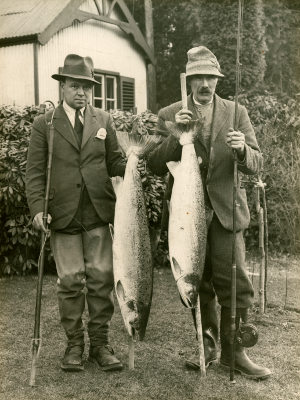
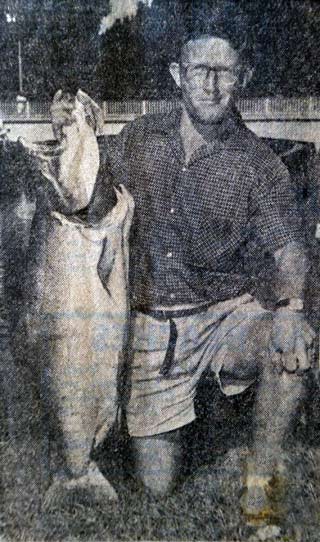
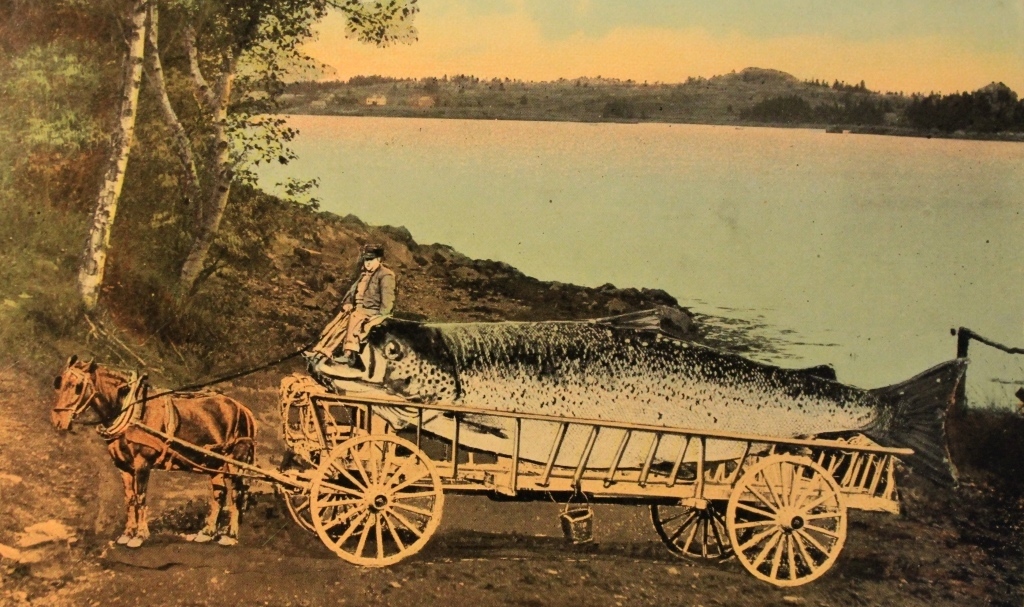
The fish on the left = 1930s. On the right (ex. Fishing Mag) from Rakaia 1970 = 40 lbs
Fishermen are usually accused of exaggerating the size of their catch. We may need to do more of that in the future.
With the exception of the Mackenzie Country hydro canals our trout and salmon are reported (anecdotally anyway) as getting smaller than they were in our dads’, or grandads’, day. Is this man-made evolution in operation?
The bases of evolution are as follows (bear with me on this, and forgive any jargon, as my highest academic qualifications are in Biology): variation, competition and selective pressure. Every species has variability within its members; just look at your own siblings or children.
As the members of the species compete for resources, some are more successful than others. These successful individuals are thus more likely to breed and therefore produce more off spring. If the advantage that they had is as a result of a difference in their DNA, (a genetic variation) then that advantage is also passed on to those offspring.
Advantage comes not only from competition within the species but also relates to habitat/environmental change and variation. A person with lots of melanin in his skin will survive better in the searing heat of the African savannah than a pink skinned Scotsman.
The selective pressures are thus sometimes climatic, and sometimes related to any of the many resources that the individual needs to survive e.g. food and shelter. It can also be from competition with other species. The house mouse rapidly replaced the kiore in the beech forests in the19th century as an example.
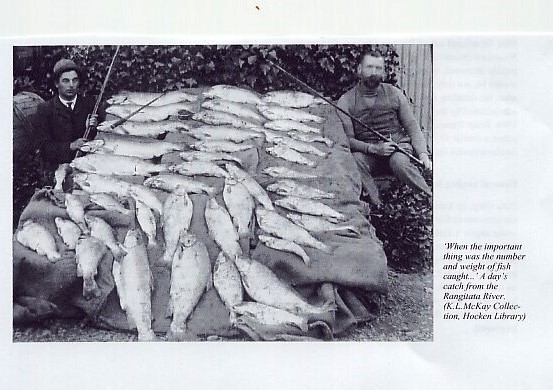 Predation is also an important example of one species determining the evolutionary direction of another. Those which can avoid predation by having camouflage colours (or shapes), avoidance behaviours, special spines or poisons, etc, are therefore more likely to survive and reproduce. Those that look like a juicy meal will not.
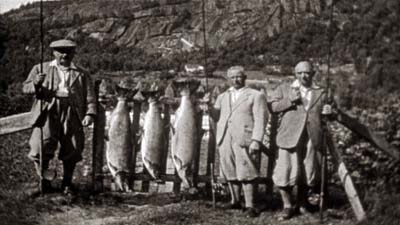
Yesteryear – Site unknown. Clothes suggest c1920
Those of us who are successful in our fishing are major predators of trout and salmon. However we predate on the adults only. We take the most aggressive; those best equipped to compete with their peers. This is the exact opposite of what usually happens in nature. It is the young, slow, or injured antelope that gets caught by the lions.
The fish we keep are the ones that are old enough to breed. Very few fisher-folk keep 250 mm long fish. Most of those who “harvest” these species will, however, keep a 2 kg trout or a 5 kg salmon. In the case of salmon virtually every fish caught over 4 kg gets harvested.
 Selwyn Huts 1920s
An effect reported with other fish species, notably the North Atlantic cod, is that the catching the larger members of the species, in big numbers, has effectively resulted in the removal of “bigness” genes from the population. Researchers have found that normal variation produces some individuals which become sexually mature before they reach the harvest size determined by the fishing regulations or the “market”. It is therefore clear that without the breeding competition from their bigger, and often more aggressive, relatives these smaller adults become the new “alpha” individuals; the successful breeders.
The fishmongers in London who complain about the small size of the cod these days tend to assume that only small to medium size fish are being targeted. That assumption extends to thinking that the fish caught were younger than those of yesteryear. Otolith studies, etc, show that these fish are the same age as those big ones of years ago. It is just that the genes for “bigness” have been largely removed from the North Atlantic population.
Perhaps that is exactly what we have done to our trout and salmon stocks!
I realise the difficulties, especially with salmon, of policing a maximum size regulation. I also acknowledge that I am not fully convinced that the scientific basis for this hypothesis is “proven”, but it has a haunting logic about it.
Maximum size limits for harvesting already occur in some high country waterways for both trout and salmon (e.g. Lake Heron). If the science was done how happy would you be with a moratorium on the keeping a trout over 1.5 kg, or a salmon over, say, 6 kg? There are a lot of unknowns about the fish that we are currently harvesting and, as with the cod, size may not always be the best indicator of age but there is a real chance that we are reversing average trout and salmon sizes in our wild populations by our harvesting practices, and those of the past.
Addendum: On the TV programme ‘Cheers” there was a regular character called “Big Norm”. He used evolutionary theory to promote the benefits of beer drinking.
Norm’s hypothesis, known as the Buffalo theory” was as follows:
Mountain lions descend to the plains and follow the buffalo herds. When they attack, the herd “takes off”, primarily to protect their young. The speed of the herd is determined by its slowest member. The cougars cannot keep up with the herd for long so they target its weakest member (usually injured or infirm), make their kill and stop to devour it. The herd, without their weakest member, can then pick up speed and rapidly escape.
Norm had read that alcohol kills brain cells. He postulated that the alcohol would similarly kill the weakest brain cells first, thus allowing the brain to work faster and more efficiently. This is why, after a few drinks, we become more knowledgeable as our brain speeds up; and thus more able to solve the problems of the world.
I’ll drink to that.
Rex N. Gibson
Aquaculture students are taught the importance of “feed & seed”.
The size of our wild salmon and trout reflect the relative abundance of feed.
Prevalence is related to the fish’s ability to reproduce.
Thanks to intensive agriculture (nitrate, sediment, and reduced flows) there is less feed.
I.e. smaller fish.
Sediment plus nitrate = poor survival of eggs and fry = less fish
This is not genetics or selection, this is due to degraded aquatic ecosystems.
Politically it is from emphasizing the economy and dismissing the Environment.
Corporates have yet to learn that they need healthy environments if they are to survive for the long term.
Trashing the environment for short term gains will result in fewer people and less natural capital resulting in diminishing economies.
This is simply poor government.