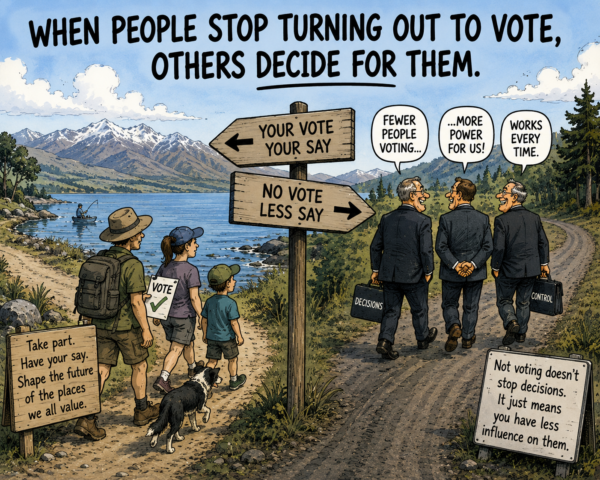
Election years bring renewed attention to participation, but also highlight a consistent pattern: many people choose not to vote. The reasons vary - disengagement, frustration, or a belief that one vote makes little difference. That may seem reasonable at an individual level, but taken together it produces a different outcome.
Across a wide range of areas - conservation management, fisheries settings, access to land and water, public safety, and wider governance - decisions continue to be made. These are not abstract matters. They shape how rivers, coasts, forests and open spaces are used and managed over time. Stepping away from the voting process does not remove those decisions; it reduces the number of people influencing them.
Lower participation does not slow the system. Influence becomes more concentrated among those who remain engaged, and the breadth of representation narrows. That may not be obvious in any single election, but over time it alters how closely outcomes reflect the wider public and how durable those outcomes are.
This pattern is not new. Participation levels have shifted across different elections, but the system continues to function regardless. As engagement declines, decision-making proceeds with a smaller base of input, and that affects both direction and balance over time.
Public resources carry public responsibility. The management of access, environmental limits, and recreational use is shaped through decisions made within a democratic framework. Participation in that framework is one of the few direct ways individuals can influence those outcomes.
This is not about political preference. It is about whether people take part in decisions that will be made regardless, and whether those decisions reflect a broad base of involvement or a narrower one.