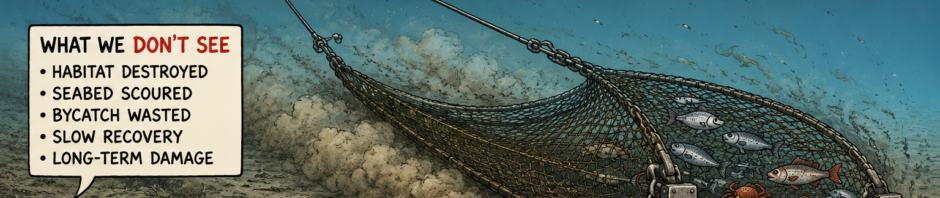
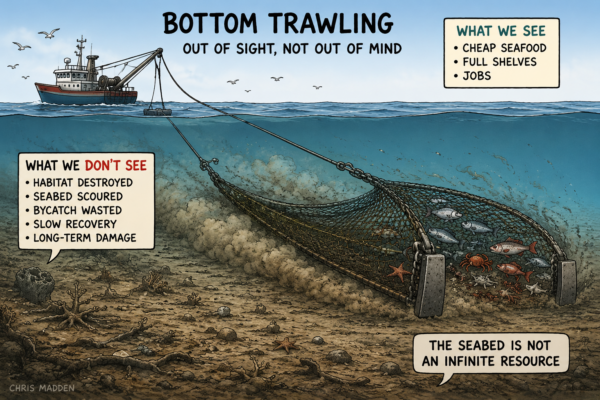
Bottom trawling is again under scrutiny as fisheries legislation moves through reform. The method accounts for a significant proportion of New Zealand’s commercial catch and is often presented as an efficient and established part of the industry. At the same time, it remains one of the most debated practices in marine management. The issue is not simply whether it is used, but how its impact is understood and accepted.
The difference in this case is not the presence of regulation, but the level at which impact is considered. Bottom trawling operates in close contact with the seabed, affecting habitats that support marine life beyond the target species. Assessment frameworks tend to focus on stock sustainability, while the condition of the seabed itself receives less consistent attention. Taken together, this creates a system where catch levels may be managed, but broader ecosystem effects are less clearly defined.
This changes how marine resources are utilised. Fisheries depend not only on the species being harvested, but on the environments that sustain them. Seabed habitats can take extended periods to recover, and in some cases may not return to previous condition. Where methods affect both the resource and its supporting system, the boundary between use and degradation becomes less clear.
This pattern is not unique to fisheries. Across multiple resource sectors, efficiency and output are often well measured, while system condition is less visible. Individually, each activity may meet its immediate objectives. Taken together, they can erode the underlying capacity of natural systems to sustain use over time. The question shifts from what is taken, to what remains.
Public marine resources are held on behalf of all New Zealanders. Their management requires a balance between use and long-term ecological sustainability. Methods that extract value while altering the systems that produce it require careful consideration, particularly where impacts are slow to recover or difficult to measure fully.
This is not about whether fishing should occur, or whether methods should evolve. It is about whether the way those methods operate remains compatible with the condition of the marine environment. The issue is not efficiency alone, but whether use and impact remain in balance over time. Bottom trawling fails us here.
Ban bottom trawling!
And get a new Minister of Fisheries without baggage!
David Attenborough has obviously had a significant influence in the support for a ban. “ALL” we have to do is to get a few more respected celebs to to the same – if only. It is a bit like harvesting hay and churning up the underlying plants, soil, and all. – Not much use for grazing then!
Bottom trawling is rape.