
Conservation in New Zealand has traditionally focused on rivers, forests, wetlands and wildlife. These are places we can see, visit and protect. Yet there is another part of our natural environment that is quietly disappearing above our heads. Increasingly, the night sky itself deserves to be recognised as a conservation resource.
Recent research suggests light pollution in New Zealand is increasing at around 3.2 percent each year, faster than the global average. Around 97 percent of New Zealanders now live beneath skies affected by artificial light. The consequences extend well beyond making it harder to see the Milky Way or Matariki. Artificial light changes animal behaviour, disrupts ecosystems and gradually severs one of our oldest connections with the natural world.
Many native species depend upon darkness. Wētā avoid illuminated areas, bats reduce their activity, seabirds become disoriented, and insects are drawn away from their natural habitats. Even birds alter their dawn chorus in response to artificial night lighting. These changes occur gradually, making them easy to overlook until they become widespread.
For Māori, Matariki is far more than a group of stars. It marks the Māori New Year and carries deep cultural meaning centred on remembrance, renewal and planning for the future. For all New Zealanders, a truly dark sky provides perspective, wonder and a reminder that we remain part of the natural environment rather than separate from it.
The concept of protecting darkness is not new. More than twenty-five years ago I suggested at a meeting of DOC and NGOs that New Zealand should consider setting aside at least one area where future generations could always experience a genuinely dark night sky. The idea was met with laughter by the DOC CEO. Today, internationally recognised Dark Sky Reserves demonstrate that protecting darkness is neither fanciful nor anti-development. It is now accepted as a legitimate conservation objective.
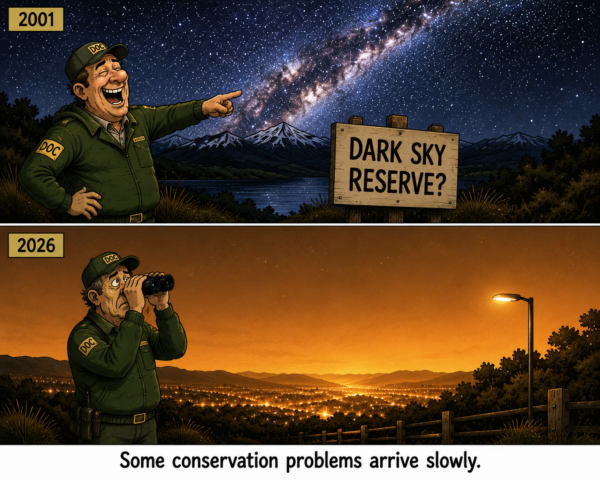
The encouraging news is that solutions are both practical and affordable. Well-designed lighting directs light downwards rather than upwards. Warmer coloured lighting reduces ecological impacts. Advertising lights do not need to operate throughout the night, and sensible planning rules can preserve dark skies while maintaining public safety. Communities such as Aoraki Mackenzie, Wairarapa and Rakiura have already shown that good lighting practice and modern development can comfortably coexist.
Darkness is not the absence of something valuable. It is something valuable in its own right. The issue is not whether New Zealand should have lighting. It is whether we are prepared to manage that lighting carefully enough to preserve one of the last truly universal natural experiences: looking up and seeing a sky full of stars.
Many politicians with there heads in the clouds and stars in there eyes, humans have interfered with nature since time began, they’re not going to change any time soon, if if it’s stuff there own kids futures.