Rethinking a Deeply Embedded Assumption
Opinion by Andi Cockroft. Chair, CORANZ
In New Zealand environmental debates, one comparison is often made so casually that it has hardened into something like fact: that introduced deer simply replaced the browsing role once filled by moa. The implication is clear - heavy browsing pressure is “unnatural,” forests evolved without mammals, and deer therefore represent an ecological distortion that must be removed wherever possible.
But when you look more closely at how deer actually browse - and how moa almost certainly did - that assumption begins to look surprisingly weak.
A convenient comparison
The moa–deer comparison is appealing because it seems to solve an uncomfortable contradiction. If New Zealand’s forests evolved under heavy herbivore pressure from moa, then the presence of large browsing animals is not, in itself, alien. The problem, it is often argued, is simply that deer are the wrong herbivore.
Yet this reasoning often glosses over a critical detail: not all browsing is the same.
How deer browse
Modern deer in New Zealand are selective, mobile feeders. They:
- Prefer soft, palatable understory plants
- Repeatedly browse favoured species, often at reachable heights
- Create browse lines that suppress regeneration below head height
- Concentrate pressure along edges, tracks, river flats, and easier terrain
Over time, this can simplify forest structure - not by removing all vegetation, but by skewing regeneration toward species deer avoid or cannot reach. It is this selective pressure, rather than sheer consumption, that causes long-term ecological change.
How moa likely browsed
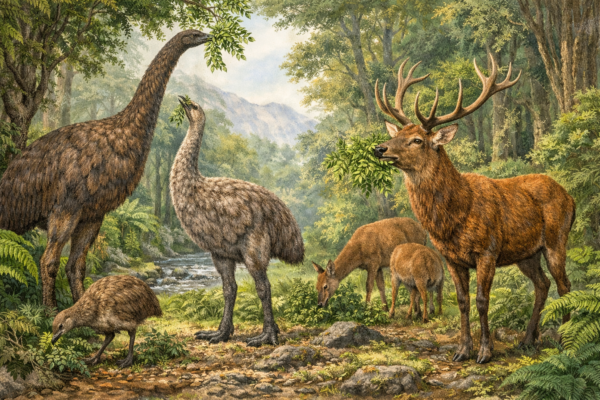
Moa, by contrast, were not mammalian grazers. They were large, flightless birds with:
- No teeth and no chewing
- Beaks adapted for plucking and stripping rather than cropping
- Digestive systems more akin to other large birds than ruminants
Evidence from coprolites, gizzard stones, and plant damage patterns suggests moa browsing was:
- Less selective at a fine scale
- Spread across a wider vertical range, including higher foliage
- Intermittent rather than repeatedly focused on the same plants
Rather than creating persistent browse lines, moa likely produced patchy disturbance, breaking branches, stripping leaves, and moving on. This kind of browsing can stimulate regeneration rather than suppress it - particularly in forests adapted to disturbance.
Different pressure, different outcomes
This distinction matters.
Forests respond very differently to:
- Continuous, selective pressure at a fixed height
versus - Episodic, variable pressure across heights and species
One simplifies structure. The other reshuffles it.
Moa browsing may have:
- Maintained open understorey mosaics
- Prevented dominance by a small number of species
- Encouraged plants adapted to regrowth, toughness, or height escape
Deer browsing, on the other hand, often:
- Locks forests into arrested regeneration states
- Favours unpalatable or exotic plants
- Reduces diversity over time
The similarity is superficial. The ecological function is not.
Why this matters now
This is not an argument that deer cause no damage. In many places, they clearly do. But it is an argument against lazy analogies that treat all herbivory as equivalent.
If moa and deer exert fundamentally different browsing pressures, then:
- We cannot assume deer are simply filling a lost niche
- Nor can we assume that “pre-human” forest structure is a valid benchmark everywhere
- And we should be cautious about universal prescriptions based on that assumption
New Zealand’s landscapes have already undergone multiple irreversible shifts - climatic, ecological, and human. Pretending we can rewind to a moa-dominated baseline may be comforting, but it risks oversimplifying reality.
Implications for management
For recreation and access groups, this matters because:
- Deer control is often used to justify large-scale closures
- Hunting access is restricted under claims of ecological emergency
- Public involvement is sidelined in favour of technocratic solutions
If impacts vary by terrain, forest type, and browsing history - which evidence increasingly suggests - then blanket pest narratives become harder to defend.
Targeted management makes sense. Context-blind eradication does not.
Coexistence versus control
There is also a cultural dimension. Deer are now part of New Zealand’s lived landscape - not just ecologically, but socially. They are valued by hunters, admired by the public, and increasingly visible even in peri-urban spaces.
Acknowledging that deer are not moa does not require demonising them. Nor does it require denying ecological impact. It simply asks for honesty about the differences - and humility about what we really know.
A better question
Instead of asking:
“How do we get rid of deer to restore forests?”
We might ask:
“Where do deer cause unacceptable harm - and where do they simply change the system we now inhabit?”
That shift in framing matters. It opens the door to:
- nuanced management
- shared responsibility
- continued public access
- and a more realistic relationship with the landscapes we actually live in
Conclusion
The idea that deer are just mammalian stand-ins for moa is tidy, persuasive - and probably wrong. The differences in browsing behaviour, selectivity, and disturbance patterns are profound.
New Zealand deserves better than simple stories. Our forests, our wildlife, and our public access policies depend on understanding complexity - not flattening it for convenience.
We can assume deer generally – note generally – fill the browsing niche vacated by moas after they were exterminated by the 13th century wave of Polynesian migrants.
There may have been variations in the vegetation species browsed but basically whether moa or deer, palatable species will be less and be replaced by more unpalatable species.
In other words the only change is a change in the species composition of the “forest.”
One of NZ’s greatest ecologists Dr Graeme Caughley said broadly speaking deer replaced the ecological niche filled by moas. He was not alone in this view as several scientists at a “Moa, Mammals and Climate Change” seminar about 1987 said the browsing of deer and moa were “not dissimilar.”
The forest the early 19th century European settlers saw was “unnatural” in the words of Dr Caughley whereas the 12th century Polynesian colonists saw an “open” forest browsed by the several moa species.
The article above states that moa beaks were for plucking and stripping plants unlike deer that browse, it doesn’t take much research to show that some moa beaks could cut twigs up to 6 millimetres in diameter.
Most likely they ate different species of plants but the end result would be the same open forest floors for ground enabling ground feeding birds to survive.
Interesting stuff. It’s about time that some real research was done, rather than the usual anti-deer political nonsense.
Okay Postman Pat, but there’s good scientists and not-so-good, the latter often being commissioned and paid or in a well salaried job, e.g. DoC scientists.. They don’t bite the hand that feeds them i.e. money.
What is needed is independent scientific work with credibility.