More Questions We Still Aren’t Answering
Guest Post by Steve Hodgson
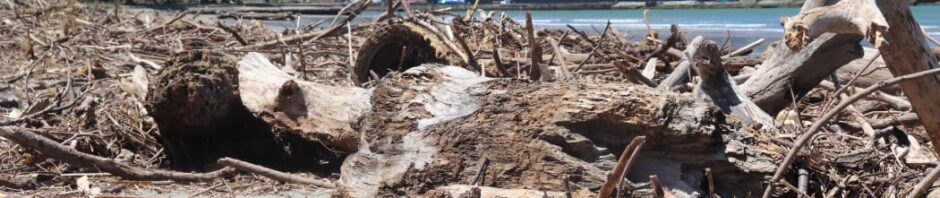
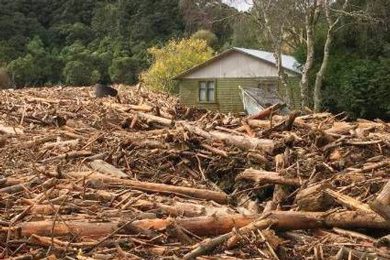
After every major storm, the same images appear: rivers choked with logs, beaches buried in debris, bridges damaged, tracks closed, and communities left to clean up the aftermath. The material is described as “forestry slash”, but the questions it raises go well beyond forestry itself. They go to responsibility, prevention, and who ultimately pays when commercial land use damages public landscapes.
The first question is a simple one: why does slash keep entering rivers at all?
Slash is not a natural feature of New Zealand’s waterways. It is the residue of large-scale harvesting, often on steep, erosion-prone land. Its mobilisation during heavy rain is not a surprise. These catchments are well known, the rainfall patterns are increasingly well understood, and the behaviour of woody debris in floods has been documented repeatedly. If the outcome is predictable, why is it still treated as an accident?
If slash movement is foreseeable, why is it still labelled storm damage rather than operational failure?
In most industries, foreseeable harm requires preventative design. In forestry, slash is often described as something that “escaped” due to extreme weather. That framing matters. It shifts responsibility away from harvest scale, coupe design, debris management, and slope stability, and toward nature itself. But if storms are now part of the expected operating environment, at what point does “extreme” simply become normal?
Another question follows naturally: why are forestry operators not routinely required to stabilise slash before harvest is complete?
In many regions, slash is left on slopes, in gullies, or behind makeshift barriers, even where downstream values are obvious. Why are mandatory stabilisation measures not standard practice? Why is removal or secure containment treated as optional, negotiated, or site-specific rather than a baseline requirement for high-risk terrain?
That leads to a more uncomfortable question: why is prevention treated as discretionary, but clean-up treated as inevitable?
When slash damages rivers, beaches, roads, or tracks, the response is almost always reactive. Councils, emergency services, contractors, and volunteers step in. Public money is spent. Access is lost. Yet the cost of preventing the damage in the first place is rarely enforced upstream. Why is the public effectively underwriting the risk of a private commercial activity?
There is also the question of enforcement. If legal responsibility already exists, why is it so rarely exercised?
Forestry activities sit within environmental regulation. Discharges to water are not permitted by default. And yet prosecutions and meaningful penalties remain rare. Is this because breaches are genuinely hard to prove? Or because enforcement agencies lack resources, political backing, or confidence to pursue large operators? And if enforcement is the exception rather than the rule, what incentive remains to change behaviour?
Closely linked is the issue of scale. Why does harvest scale matter so little in regulatory settings?
Large clear-fell coupes on steep land produce vastly more debris than smaller, staged harvests. The relationship between scale and risk is obvious. So why do rules still allow extensive contiguous clear-felling in erosion-prone catchments? If smaller coupes reduce slash mobilisation, why are they not required as a condition of consent?
Another critical question concerns bonds and guarantees. Why is there no mandatory financial bond to cover downstream damage and reinstatement?
In many high-risk industries, operators must post bonds or contribute to remediation funds before work begins. Forestry largely does not. Without a bond, there is no automatic funding for clean-up, no immediate accountability, and no financial signal that risk must be managed in advance. Why is forestry treated differently?
Then there is the question of reinstatement. Why are damaged rivers, beaches, and tracks not automatically reinstated at the operator’s expense?
When public infrastructure is damaged, responsibility is often contested, delayed, or diluted. Recreation sites remain closed for months or years. Riverbeds are left altered. Beaches are stripped of amenity. Why is reinstatement not compulsory once slash is proven to originate from a harvested catchment? Why must communities argue for restoration rather than expect it?
From an outdoor recreation perspective, another question looms large: why are access and recreation values so rarely factored into the cost of slash events?
When rivers become unsafe to fish, paddle, or swim in; when tracks are closed; when beaches are unusable - those losses are real. Yet they rarely appear in assessments of harm or compensation. Why is the loss of public use treated as incidental rather than as damage in its own right?
There is also the issue of climate change. If storms are becoming more intense and frequent, why are forestry rules not tightening rather than loosening?
A changing climate increases risk. In most sectors, increased risk leads to stronger controls. In forestry, industry voices increasingly argue for reduced liability, citing the very storms that make better controls more necessary. Is that a sustainable approach, or simply an attempt to socialise growing risk?
Finally, there is the governance question. Who is the system currently designed to protect?
Is it designed to protect rivers, beaches, communities, and public access? Or is it designed to protect production continuity and limit industry exposure? If the same damage happens repeatedly, in the same places, after the same type of harvesting, what does that say about the balance of interests embedded in regulation?
For CORANZ, these are not abstract policy debates. They go directly to the condition and accessibility of the outdoors. When slash fills rivers, recreation is lost. When beaches are buried, access is degraded. When tracks are damaged, the public pays twice - once through taxes, and again through lost opportunity.
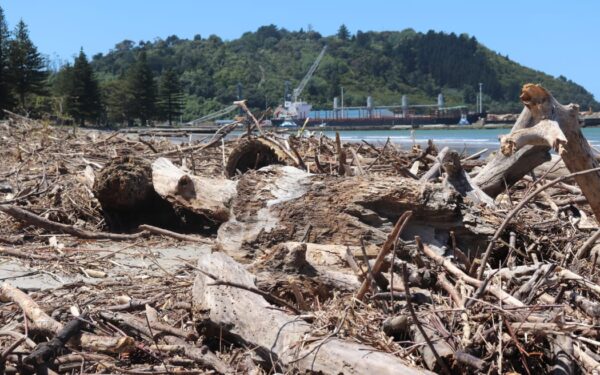
Perhaps the most important question of all is this: how many more storms, and how much more damage, will it take before prevention is treated as mandatory rather than optional?
Until that question is answered honestly, slash will continue to move downhill - and the costs will continue to flow outward to the public spaces New Zealanders value most.
At both central and local government level, there seems ignorance of the environmental folly of monocultures, in this case, pines.
Monocultures covering large swathes of country diminish greatly bio-diversity, are a fire risk and threaten rural communities witrh depopulation.
The sooner it becomes compulsory to dispose of slash, the sooner somebody will come up with an economic use for it. More regulations around forestry are needed NOT less! Both landowners and forestry harvesters need to be jointly accountable – even if its crown land.
After a Gabrielle the government publicly stated that the Foresters would be made accountable for the slash and the damage it may cause in the future, well, the future is here and sadly many areas in New Zealand have again been devastated, but can’t hear the call for heads.
Local governance should be held accountable
A lawyer’s website I looked at actually cited forestry slash as a problem for which a landowner could bring a court case, using the tort (civil wrong) of nuisance.
Don’t know if any East Cape landowners have got around to legal action but it looks like they could have a good case.