
Sentiment among the New Zealand mainstream environmentalist community is to get rid of this ‘pest’ by any means possible (e.g. “hit them, and hit them hard” or “the only good possum is a dead possum”).
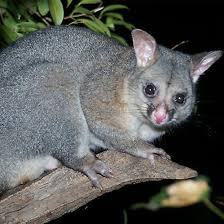
For a few seconds, I held out a blueberry in front of the wooden nest box. My hand shook ever so slightly, I had yet to physically meet a brushtail possum (Trichosurus vulpecula) before. A black paw timidly appeared from the darkness and quickly plucked the blueberry from my palm. I peered around the corner, my eyes adjusting to the darkness of her nest box, and saw her. She had beautiful beady eyes, this gorgeous pink nose, and massive fluffy ears. Only her head was visible; her body was cocooned in this fleece blanket that lined her nest box.
She was found as a tiny joey clinging onto her dead mother, who was killed by a vehicle and left to die on the side of the road. Had someone not checked her mother’s body, she would have starved to death as her mother’s milk dried up, just another casualty of New Zealand’s war on possums. As I stared at her happily popping blueberries into her mouth, it was quite clear to me that she, and those like her, were anything but ‘voracious’ as so vigorously claimed. How could this even happen?
Framing of a Villain
To understand this framing, it is important to have some background on the history of possums in New Zealand. Possums were successfully introduced from Australia in 1858 by British settlers seeking to establish a fur trade. The region, described as a ‘bird’s paradise’1, was largely mammal-free, except for a few species of native bats and marine mammals. Despite New Zealand changing radically since colonial settlement (e.g. from land use change to species composition), this notion of the environment as ‘pure’ has not only been reinforced since then, but it has become an integral part of New Zealand’s global identity (e.g. the 100% Pure New Zealand tourism campaign, touted as a massive marketing success in reinforcing New Zealand’s brand2).
These newly introduced possums spread into the bush with ease; they were without the predators that maintained their numbers in their Australian homeland and had forests full of vegetation to eat. These possums, favouring the seclusion of the remote bush, proved rather difficult for humans to access and control, making the harvesting of fur, the whole reason the possum was there, much more difficult to mechanise.
In response to possums spreading unabated further into forests and revelation they were vectors of bovine tuberculosis (thus threatening two of the nation’s primary economies of dairy and beef), government agencies and conservation authorities began an aggressive process of framing possums as villains, describing them in terms such as a “pest of plague proportions” with “voracious appetites”3.
Despite possums being arboreal folivores with a digestive system similar to herbivorous horses and rabbits (called hindgut fermentation4), they are blamed for extensively predating on endangered native birds and their eggs (though these claims are dubious as research on the dissection of thousands of possum stomachs revealed less than 0.1% contained non-plant matter5). This framing contributed to possums, along with rats and stoats, to become targets for complete eradication in an aggressive, and highly unrealistic, country-wide propaganda campaign, Predator Free 2050 (PF 2050). Fuelled by complex intersections of colonialism, human supremacism, and nativism, PF 2050, and its accompanying conservation ‘education’, is in full swing in Aotearoa New Zealand.
Anything Goes
Sentiment among the mainstream environmentalist community is to get rid of this ‘pest’ by any means possible (e.g. “hit them, and hit them hard”6 or “the only good possum is a dead possum”7). Young children are actively encouraged to participate in the killings and celebrate their contribution to ‘conservation’, with events such as dead possum dress-up contests8 and possum hunting fundraiser events (including the infamous event in 2017 where children drowned joeys in a bucket while onlookers watched9). Those who engage in ‘pest’ control activities are regarded as patriotic citizens10 whom are fighting the enemy (the ‘invasive’ possum) to ‘restore’ New Zealand to its pre-human ‘pristine’ state. They are popular targets for motorists, with squashed possums being a popular icon for road-trip bingo. Possum fur has even been referred to as “eco-friendly” and “cruelty-free”11 as the existence and support of the possum fur trade is framed as eco-consumerism that protects native flora and fauna. To adhere to possum-hating rhetoric is almost a prerequisite to be a proper, patriotic Kiwi10. It is almost as if, for the brushtail possum in New Zealand, anything goes.
The aggressive framing of the possum as a “voracious predator” which is destroying New Zealand’s biodiversity is simply ignoring any mention of anthropocentric pressures and squarely placing blame on a convenient scapegoat. For the brushtail possum, a protected and valued species within Australia, this marsupial is framed as a villain across the Tasman. For them to be unfortunate enough to be born in New Zealand, discourses of identity, belonging, and nativism begin to influence their treatment and whether they are deemed worthy of compassion, even in their death.
Becoming a Possum Advocate
I had not always been aware of this injustice towards brushtail possums – in fact, I was not even fully aware there was a difference between the opossum in North America and the plethora of other possum subspecies in Australasia. Originally from Canada, I moved to New Zealand in 2019 to pursue my PhD in Human-Animal Studies at the University of Canterbury in Christchurch, New Zealand. I had not picked a specific topic upon my arrival, but knew I wanted to explore something related to speciesism and the treatment of animals categorised as ‘others’. I have done research in this area before, but not on such a large scale. I was lucky enough to be paired with absolutely incredible supervisors, Dr. Annie Potts and Dr. Nik Taylor, who led by example and mentored me to become the academic activist that I now am, giving me the confidence to speak up in an environment where voices of this kind are often marginalised, ridiculed, and ostracised.
While the plight of other ‘pest’ animals is equally as important as the possum, I chose them as there was something uniquely peculiar about the aggressive nature of their framing that was unlike anything I had ever seen before, something which I needed to understand further. After meeting some rescued possums, and experiencing their gentle presence first-hand, I quickly realised the gravity of what this aggressive framing has done, and continues to do, to them. With support, I designed a research project that would allow me to best use my particular skill set to advocate for possums through the lens of compassion and empathy.
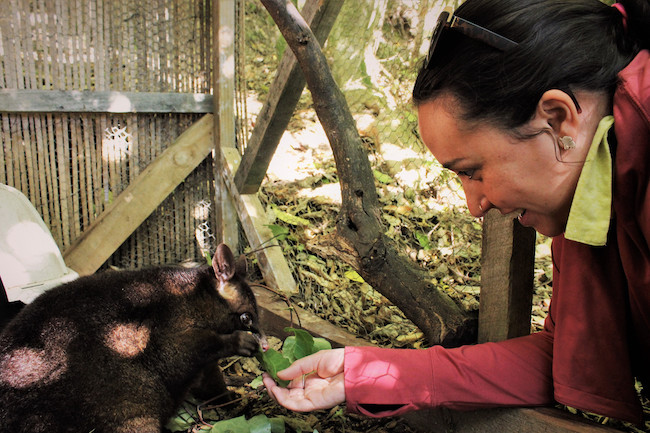
Dobby, an elderly possum I got to meet during fieldwork – he sure loved snacks! Picture courtesy of their rescuer
While this is a very short introductory post to the framing of the possums in New Zealand, there is much more to uncover (and re-frame). The more I learn, the more I want to share. This blog will attempt to grapple with these complex ideas and act as a vessel to encourage community engagement and activism. This blog would not be possible without funding from the Culture & Animals Foundation, for which I am incredibly grateful for their assistance and support.
Please share, follow, and engage with this material – not for me, but for the possums that so desperately need people to care. Thank you,
References
- https://www.scoop.co.nz/stories/SC0510/S00005.htm
- https://www.tourismnewzealand.com/media/1544/pure-as-celebrating-10-years-of-100-pure-new-zealand.pdf
- https://www.doc.govt.nz/documents/science-and-technical/everybodyspossum.pdf
- Foley, W., Hume, I., & Cork, S. (1989). Fermentation in the Hindgut of the Greater Glider (Petauroides volans) and the Brushtail Possum (Trichosurus vulpecula): Two Arboreal Folivores. Physiological Zoology, 62(5), 1126-1143. Retrieved March 23, 2021, fromhttp://www.jstor.org/stable/30156201
- https://www.scoop.co.nz/stories/AK2001/S00248/doc-not-truthful-saying-possums-are-bird-predators-coranz.htm
- Fischer, Jeannine-Madeleine. (2017). “‘Hit them hard and hit them well.’ Possums, Pollution, and the Past in Aotearoa/New Zealand.” Environment & Society Portal, Arcadia, 10. Rachel Carson Center for Environment and Society. https://doi.org/10.5282/rcc/7878.
- http://www.stuff.co.nz/southland-times/opinion/5580798/Editorial-Only-good-possum-is-a-dead-one
- https://www.stuff.co.nz/environment/100695495/teaching-our-kids-to-kill-in-name-of-conservation
- https://www.stuff.co.nz/national/94301098/animal-welfare-complaint-laid-after-possum-joeys-drowned-at-school-fundraising-event
- Potts, A. (2009). Kiwis against possums: A critical analysis of anti-possum rhetoric in Aotearoa New Zealand. Society & Animals, 17(1), 1-20.
- https://www.stuff.co.nz/business/81851424/possum-fibre-and-fur-industry-wants-to-prove-its-crueltyfree
A very good, perceptive article which Forest and Bird and DoC need to read. Thank you Emily.
While seen as a pest, NZ-sourced possum fur is also marketed internationally as an ethical, sustainable, and warm alternative to cashmere. Possum meat is excellent and marketable as pet food or even human consumption. I haven’t tried eating possum meat but a couple of friends say it’s excellent in casseroles.
Get over your hatred complex DoC, the possum is a resource. manage it as a resource not as something to be hated and subjected to a slow agonising death by poison.
As for spreading Tb, that’s a big fat lie, conjured up by OSPRI to keep highly paid salaries intact. Back in 2016, the Agriculture Minister reported to Parliament that 9800 possums were autopsied for Tb and not one infected possum was found. Bovine Tb is spread by an inefficient skin test allowing animals to be transported.
I have even seen possums classified as a predator. They are not predators- they are herbivores.
Have a look on CORANZ’s site for a simple test on possums eating eggs. Possums did not touch the eggs put out.
Besides there are Landcare Research studies where possum stomachs were examined and NO trace of eggs, feathers, bird remains etc were found.
There are so many lies and so much propaganda spread about possums and it is something New Zealand should be thoroughly ashamed of. Our clean and green image is in tatters thanks to the very people who are tasked to protect our conservation estate and its beautiful wild animals.
Gotta blame something to keep the 1080 poison gravy train moving
It all reflects the “pro-pest, anti-introduced” phobias which began with the Deer Menace Conference of 1930 organised by an amateur botanist Leonard Cockayne. One scientist said something like this that “Cockayne could not think straight when it came to deer.”
Cockayne was furious deer browsed foliage of palatable shrubs and trees. Cockayne conveniently ignored that several million moa had browsed the vegetation for 50 millions of years or so.
Possums browsed foliage too just as birds (e.g. kereru, kokako and others) browsed leaves and up on the canopy for millions of years..
Browsing is the same as pruning garden shrubs and trees the foliage grows twice as much, Demonising possums and other browsers is just scare tactics to brainwash those who have no idea and believe whatever they read.
My possum called honey is an amazing pet. She is clever cheeky adventurous and most importantly a herbivore. . Those that vilify possums have never been up close to one. Amazingly aware and bright wee animals. Too clever for the braindead at DOC that’s for sure
Once upon a time, somebody in New Zealand got some funding to aerially apply 1080 poison.
It’s a WHO classified Class 1A ecotoxin .. which kills by breaking the Krebs cycle .. meaning it indiscriminately kills anything that consumes oxygen. It acts both directly, and via secondary poisoning .. killing target and non-target .. introduced and indigenous .. vertebrate and invertebrate .. mammalian, avian, reptilian, and insect .. and does so indiscriminately.
Its continued use is a heinous crime against wildlife .. a war on nature.
So the magnitude of the problem it is supposed to be combatting .. must also be massively exaggerated.
Hence, the propaganda campaign. Every aspect of the impact of possums in New Zealand is either exaggerated .. or is downright lies.
They are supposed to be the biggest vector for the spread of TB .. but nobody has hardly ever been able to even find a possum with TB, let alone them be spreading it.
They are supposed to be eating the New Zealand bush to destruction .. but napalming the bush with Aerial 1080 for years and years .. has made no discernible difference.
Despite everything being in their favour, food wise .. they are supposed to have suddenly switched to become massive predators of birdlife .. despite a complete lack of credible evidence to support this absurd claim.
Hitler and Goebbels discovered a terrible truth, and used it to devastating effect.
If you tell a lie that’s ridiculously big enough .. and if you tell that lie often enough .. then people will come to accept it must be true.
We’ve seen the same thing even more recently, with Covid. We took a virus with a 0.16% morbidity rate .. and used it as the basis for a massive propaganda campaign .. to justify wrongdoing on a scale never seen before .. to sell billions of dollars worth of unjustified pharmaceutical products .. that have pushed up excess death rates in all the countries where they were used extensively .. and still most of the the population remain stupefied.
So it’s no wonder the propaganda campaign against the poor ole possum has been so successful. Most of what is said about them .. simply isn’t true.
Don’t get me wrong .. humans are responsible for a bunch of wild, introduced species here in New Zealand. Responsible population management is necessary.
But the goal of eradication is as reckless and irresponsible .. as it is unaffordable, and unachievable.
But those promoting the lies know the old adage .. never let the truth get in the way of a good story.
Not while the funding is still available, anyways …