Maybe Not Anymore
For years we have been told that Polyfluoroalkyl Substances (PFAS) contamination is effectively permanent - that rivers, lakes, estuaries, and groundwater affected by so-called “forever chemicals” are simply lost. The public response has usually been the same: warning signs, fishing bans, swimming advisories, and quiet restrictions on access that are rarely lifted again. Cleanup, we are told, is too slow, too costly, or technically impossible.
A new discovery from Rice University suggests that excuse may no longer hold.
The problem with PFAS
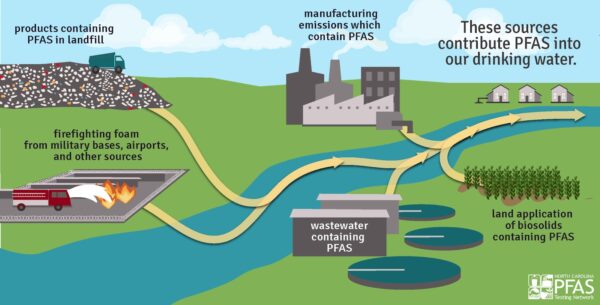
PFAS (per- and polyfluoroalkyl substances) are a family of highly persistent industrial chemicals used in firefighting foams, non-stick coatings, stain repellents, and a range of industrial processes. Their defining feature - extreme chemical stability - is also what makes them such a problem. Once released into the environment they do not readily break down, accumulating in water, sediment, wildlife, and people.
Around the world, PFAS contamination is increasingly being cited as a reason to restrict or close recreational access to water. Swimming holes become “unsafe”. Shellfish beds are closed indefinitely. Fishing advisories quietly harden into de-facto bans. In many cases the contamination source is historic or long since controlled, yet the public pays the price through permanent loss of access.
Why cleanup has stalled
Traditional PFAS treatment methods exist, but they come with serious limitations:
- Activated carbon filters are slow and quickly saturated
- Ion-exchange resins are expensive and generate hazardous waste
- Both methods generally trap PFAS rather than destroy them, shifting the problem elsewhere
- Disposal often involves transport and incineration, with further environmental risk
This has allowed regulators and councils to fall back on a familiar position: managing public exposure rather than fixing the problem.
A different approach
Researchers at Rice University, working with South Korean partners, have developed a new PFAS treatment platform based on a material known as Layered Double Hydroxide (LDH), made from copper and aluminium.
In plain terms, the results are striking:
- The material captures PFAS up to 100 times faster than commercial activated carbon
- It adsorbs PFAS over 1,000 times more effectively than many traditional materials
- Large amounts of PFAS can be removed within minutes, not days or weeks
On its own, that would be a major improvement. But the real breakthrough lies in what happens next.
Closing the loop
Unlike most existing systems, this technology does not stop at capture. Once PFAS are adsorbed onto the LDH material, the researchers apply a controlled heating process using calcium carbonate. This has two critical effects:
- More than half of the captured PFAS are destroyed, rather than merely relocated
- The LDH material is regenerated and reused, reducing waste and cost
Crucially, this process does not release known toxic by-products. Instead of creating a second hazardous waste stream that must be disposed of elsewhere, the system largely neutralises the chemicals on site.
This “one-two punch” - rapid capture followed by on-site destruction - directly challenges the idea that PFAS contamination is something we can only fence off and live with.
Why this matters for recreation and access
For CORANZ, this matters for one central reason: environmental degradation is increasingly being used to justify loss of public access.
We see it repeatedly. Contamination is discovered, often linked to historic industrial or military activity. Rather than investing in meaningful remediation, authorities choose the cheaper, simpler option - restrict use. Over time, those restrictions become normalised. The river is still there, the estuary still flows, but the public is quietly excluded.
This new research undermines the argument that “nothing can be done”. If PFAS can be removed quickly, efficiently, and without creating another toxic legacy, then the policy conversation changes. The question is no longer whether access must be lost, but why restoration is not being pursued.
A note of realism
It is important to be clear: this technology is not yet being deployed at catchment scale. Further work is needed on cost, engineering, and regulatory approval. No single treatment method will magically clean every contaminated waterway.
But the significance of this discovery lies elsewhere. It proves that PFAS are not untouchable. It shows that remediation can be faster, more efficient, and more sustainable than previously claimed. And it removes a long-standing excuse for inaction.
From management to restoration
For too long, environmental policy has drifted toward managing decline rather than reversing it. Warning signs replace cleanup. Barriers replace solutions. Public access is lost not through overt decision-making, but through quiet administrative convenience.
Technologies like this challenge that mindset. They support a different approach - one where contaminated environments are actively restored, and where recreation, conservation, and public health are aligned rather than set against each other.
The real question
If “forever chemicals” can be captured and destroyed, then the remaining obstacle is no longer chemistry - it is will.
Will agencies continue to default to closures and restrictions, or will they invest in solutions that keep rivers swimmable, fisheries accessible, and the outdoors open to everyone?
This research from Rice University suggests that permanent loss of access is not inevitable. The science is beginning to catch up. It is now up to decision-makers to do the same.
Fox News has an article on the very thing:
https://www.foxnews.com/health/common-household-chemicals-linked-increased-risk-serious-neurological-condition
A study from Sweden’s Uppsala University discovered a link between microplastics and multiple sclerosis (MS).
The research, published in the journal Environmental International, discovered that exposure to two common environmental contaminants, PFAS and PCBs, could increase the risk of the autoimmune disease.
PFAS, or per- and polyfluoroalkyl substances, known as “forever chemicals,” are used in some common household products, such as non-stick cookware, textiles and cleaning products. They have also been found in drinking water throughout the U.S., according to the U.S. Environmental Protection Agency………………………
Not to mention Fox again (thanks for the link),
Common cleaning chemical tied to spike in liver disease across US, researchers say
Tetrachloroethylene exposure from everyday products increases liver fibrosis odds by 300%. The EPA restricted the chemical after health risks were discovered in blood samples.
https://www.foxnews.com/health/common-cleaning-chemical-tied-spike-liver-disease-across-us-researchers-say
Like all big capitalists the polluters will expect Jo Blogs taxpayer to clean up after them. Sixty years later we are still cleaning up DDT!