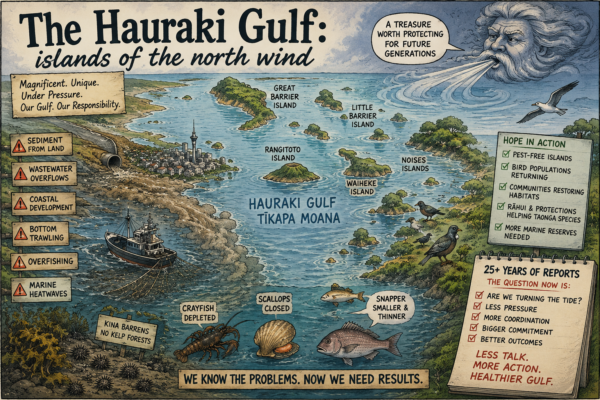
The latest State of the Hauraki Gulf report paints a familiar picture. Declining shellfish, depleted crayfish, damaged reefs, sediment, wastewater overflows, habitat loss and increasing pressure from coastal development all feature once again. There are encouraging signs in some areas, particularly the recovery of native bird populations on predator-free islands, but the overall message remains that the Gulf continues to decline.
This is now the eighth report produced over more than twenty-five years of monitoring. By any measure, that represents an enormous body of scientific knowledge. We understand the problems far better than we did a generation ago. The more difficult question is why, despite that knowledge, the Gulf still faces many of the same challenges.
The report itself makes an important point. There is no single cause for the Gulf’s decline. Fishing pressure plays a role, but so too do sediment from land use, ageing wastewater infrastructure, stormwater overflows, coastal development and changing ocean conditions. Searching for a single culprit risks distracting from the reality that many small pressures, acting together over decades, have gradually weakened one of New Zealand’s most important marine ecosystems.
There are also reasons for optimism. Predator control has allowed native bird populations to recover on several Gulf islands. Community restoration projects are making a difference. Local conservation initiatives have demonstrated that when effort is sustained over many years, nature can respond. These successes deserve recognition because they show that environmental decline is not inevitable.
The challenge now is to apply the same determination across the wider Gulf. Reports alone do not restore marine ecosystems. Neither do policies unless they are backed by practical action, adequate resources and measurable outcomes. Good management should be judged by healthier reefs, cleaner water, recovering shellfish beds and more abundant marine life, not simply by the number of reports published or plans adopted.
CORANZ has consistently supported evidence-based environmental management. After twenty-five years of monitoring, New Zealand does not lack evidence about the Hauraki Gulf. What it needs is coordinated action that addresses the many pressures identified by successive reports. Restoring the Gulf will not come from finding one problem or one solution. It will come from steadily reducing all the pressures that together have placed this remarkable marine environment under strain.
The issue is no longer understanding what is wrong. The issue is demonstrating that what we know is being translated into lasting environmental improvement.