By Editorial Team
A recent report from Radio New Zealand spotlighted what local residents in central Auckland’s Hobson Bay have endured for years: frequent sewage overflows that spoil a picturesque coastal environment, disrupt recreational use, and pose risks to public health. RNZ
It is tempting to treat Hobson Bay’s problems as a local story about aging infrastructure. But when examined closely, the underlying issues — repeating patterns of environmental degradation, deferred infrastructure investment, and slow action against known problems — reveal much about how New Zealand manages land, water, and public space. For those who value outdoor access and healthy ecosystems — including walkers, fishers, swimmers, kayakers and families — Hobson Bay is a case study worth understanding.
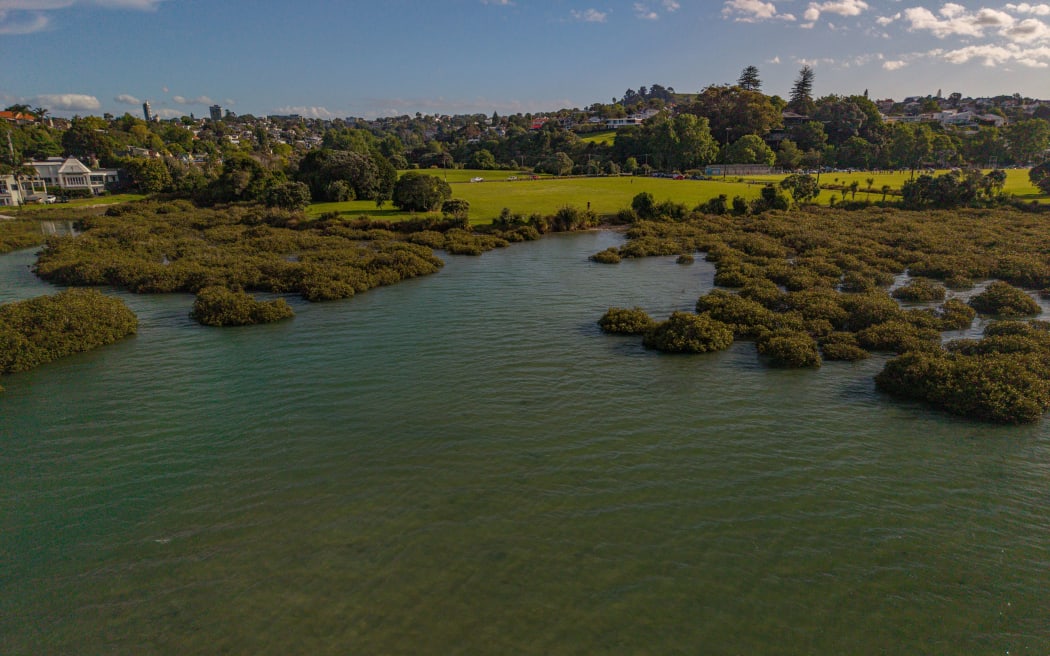
Image RNZ link here
A Bay Tarnished by Sewage — The Facts
As the article by Felix Walton and RNZ makes clear:
- Residents report sewage visible in Hobson Bay “rain or shine.” RNZ
- Dry-weather spills occur regularly due to aging, broken wastewater pipes. RNZ
- In wet weather, combined stormwater and wastewater systems overflow whenever rainfall is sufficient — a condition that affects most rain events. RNZ
- A wastewater biologist describes the situation bluntly: the bay itself is acting as an open-air treatment plant, absorbing sewage loads that should be treated at a facility. RNZ
Residents speak of warning families not to swim in contaminated water and of bacterial levels in the bay reaching figures typically seen only at the inlet of a wastewater treatment plant. RNZ
This is not the occasional foul sight after a storm. It is systemic and persistent — and it has been happening for years.
Infrastructure — Old Pipes, New Problems
Much of the Hobson Bay catchment still depends on combined sewer and stormwater pipes installed more than 100 years ago. RNZ Such systems were commonplace in early urban development, but they are not fit for purpose today as cities grow and climates shift.
Combined systems work poorly for modern urban populations because they are designed to overflow when flows exceed pipe capacity — effectively dumping untreated sewage into waterways. The Hobson Bay situation fits this pattern precisely.
Compounding this, remnants of aged infrastructure are prone to blockages and dry-weather leaks that spill raw sewage even when there has been no rain. RNZ
Despite widespread awareness of these problems, repair and overhaul have been deferred for decades. One community representative told media: “They know the problem, they know what they need to do, and they need to get on and do it.” RNZ
Fixes Are Planned — But Years Away
Some infrastructure upgrades are underway, but the timeline is distant:
Central Interceptor Project
Watercare’s Central Interceptor — a massive wastewater tunnel — is intended to reduce overflows across Auckland’s central isthmus by about 80%. Wikipedia It is due for completion around late 2026, and while it benefits many areas, Hobson Bay lies on the eastern fringe of its direct impact zone. RNZ
This project represents a necessary and important component of wastewater modernisation, but it was conceived decades after the problems were apparent.
Newmarket Gully Scheme
A separate initiative, the Newmarket Gully storage project, has been on the books since at least 2016 but remains in planning stages. RNZ+1
Proponents have estimated that it could reduce overflows in the Hobson Bay catchment by up to 50% when completed, but current estimates position completion as late as 2033. RNZ
A Generation of Environmental and Recreational Loss
To understand the significance of these delays, it helps to look at the broader picture:
- Hobson Bay’s reputation as a place to walk, launch kayaks, fish, or swim has been undermined by sewage contamination for decades. RNZ
- According to older reporting, the equivalent of at least 60 Olympic swimming pools worth of raw wastewater was entering the bay annually as recently as 2022, prompting health warnings and general avoidance. RNZ
- Persistent contamination has not only prevented safe recreation, it has diminished public confidence and enjoyment of the shoreline.
One wastewater specialist observed that 40 years of contamination equates to a full generation of Aucklanders who have missed the opportunity to enjoy this environment as it ought to be enjoyed. RNZ
This is a profound loss — not just of aesthetic pleasure, but of the tangible connection between people and place that lies at the heart of outdoor recreation culture.
Who Bears the Cost?
There are multiple forms of cost here:
Environmental Cost
Rather than being a site of clean water and thriving estuarine life, Hobson Bay currently receives raw nutrient loads that alter bacterial and oxygen conditions in ways hostile to healthy aquatic ecosystems.
Public Health Cost
Families are warned not to swim or play in water that may contain pathogenic bacteria. RNZ
Access Cost
A space that should be a recreational asset — a waterfront park, picnic spot, and watercraft launching point — becomes instead a place to avoid.
Ratepayer Cost
Residents pay wastewater charges, yet a segment of the system bypasses treatment entirely in practice. As one expert told media, current residents are effectively subsidising the environment’s role as a treatment plant, receiving no clear return for that cost. RNZ
What Does This Say About Policy and Priorities?
There are practical reasons why infrastructure upgrades take time: complexity, funding, engineering challenges, and the need for detailed planning all play a role. But the story of Hobson Bay raises broader questions about infrastructure planning and environmental risk:
- Why have combined sewer systems persisted so long in one of the country’s largest cities?
- Why has a solution like Newmarket Gully taken nearly a decade to move from promise to planning?
- Why must residents wait years — even decades — for projects that could have been initiated earlier with better foresight?
The pattern is familiar from other environmental contexts: acknowledgement of harm followed by slow action, often delayed by institutional inertia or competing priorities. This is the same pattern seen in debates over freshwater pollution, nitrate contamination, and access restrictions — issues that CORANZ has highlighted repeatedly in 2025.
Recreation and Long-Term Stewardship
For CORANZ and its audience, the Hobson Bay situation touches on several key principles:
1. Environment First
Clean water is a prerequisite for safe and meaningful outdoor recreation. When water bodies become dumping grounds — by design or neglect — the very possibility of recreation is diminished.
2. Access Is Not Just Legal — It Must Be Safe
Public access is not merely a matter of rights; it is a matter of health and environment. Gates and pathways mean little if the underlying setting is unfit for use.
3. Infrastructure Is Part of Stewardship
Investment in infrastructure is investment in long-term stewardship of land and water. Delaying upgrades is not just a budgeting choice — it is a decision that affects ecosystems, morale, and community connection.
4. Local Places Reflect National Trends
Although Hobson Bay is geographically specific, the issues it illustrates — aging systems, slow responses, environmental degradation, and delayed infrastructure — recur across New Zealand. Whether it is river pollution in rural catchments or sewage contamination in harbours, the theme is the same: we cannot take natural assets for granted.
What Needs to Happen Now
The evidence now requires that:
- Progress on existing projects be accelerated, and barriers to faster implementation identified and addressed.
- Interim measures be considered where possible to reduce immediate health risks.
- Monitoring results and progress reports be regularly published so the community can better understand timelines and expectations.
- Long-term strategic planning integrate environmental protection, recreation needs, and infrastructure renewal as co-equal goals.
Hobson Bay is not a remote backwater. It is a central part of Auckland’s heart, and its condition is a reflection of how well — or how poorly — contemporary policy aligns with environmental and recreational values.
Conclusion
The Hobson Bay sewage saga is, at first glance, a coastal infrastructure problem. But at a deeper level, it is a reflection of how we in New Zealand value — or fail to value — our waterways and outdoor spaces. When a bay becomes a sewer outfall time and again, we lose far more than clean water; we lose connection, confidence, and the freedom to enjoy a shared natural world.
For CORANZ, Hobson Bay is a reminder that environmental health, recreational access, and infrastructure stewardship are inseparable. Without meaningful action now, we consign future generations to a legacy of degraded places and lost opportunities — a cost far greater than any engineering challenge.
You’d think with all the bureaucrats here in WellyWood,residents here affected by the exact same problems that they would at least fix these self same issues in the nation’s capital – but NO.
We have exactly the same issues – or perhaps the latte-swilling leftish bureau-types don’t live on the coast so don’t care – same as they don’t care about some small hamlet over 600 Km away.