
by Tony Orman
The country’s largest orange roughy fishery is again on the verge of collapse. A new stock assessment in 2025 has confirmed that the fishery’s stock is close to collapse (8-18% biomass) with one of four models showing it may have already collapsed.
It’s not the first time.
Back in the 1980s the orange roughy fishery collapsed.
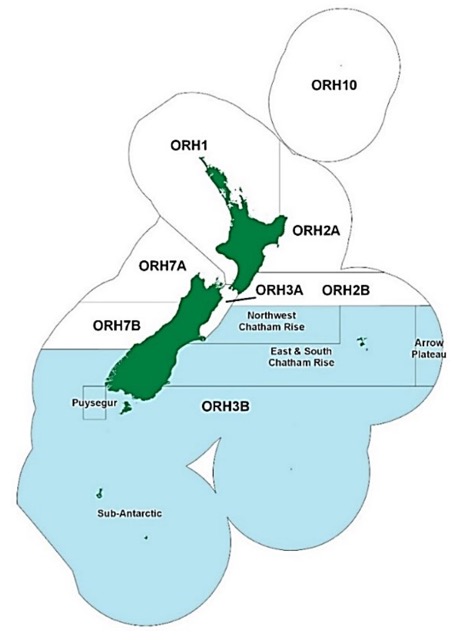
One of the orange roughy fisheries – there are several – the Challenger Plateau (ORH7A) fishery, for example,was closed in 2001 after being over-fished to just 3% of its spawning stock biomass. Others were over-fished also and reduced to something like 15% and 17%.
About 1979 I was then president of the New Zealand Recreational Fishing Council and when in the late 1970s the orange roughy fishery was discovered, I made a press release, reported in the “NZ Herald” (Auckland) that extreme caution was needed as management must be dictated by full knowledge of the population dynamics of the species, i.e. when and where the species spawned, longevity and other characteristics.
Golden Egg
My statement drew criticism from the government’s Duncan McIntyre who was fisheries minister 1979 to 1984 who said there was nothing wrong with catching spawning fish.
I replied stating that was nonsensical as it was “killing the goose that laid the golden egg.”
I’m no scientist but then nor was minister Duncan McIntyre. He and his ministry were to prove to be so wrong.
I was correct – sad to say.
Orange roughy live up to 250 years and do not breed until they are 25–30 years old, meaning they cannot recover quickly from over-harvesting. In line with the age (250 years) they are very slow growing and thus extremely vulnerable to over-fishing.
Even an intelligent 3rd former could see that.
Minister Duncan McIntyre and the ministry couldn’t.
They needed to go back to school and in the “slow learner” class.
Consequently due to the fish’s slow growth and late maturity and likely fishing during spawning, the “orange roughy gold rush” of the 1980s led to the rapid population crashes by the early 1990s.
All Over Again
Now it’s happened again.
A 2025 scientific report released by the Ministry of Primary Industries has put the population of orange roughy on the East and South Chatham Rise at 8-18 percent of its original biomass.
The fishery has a “soft limit” of 20 percent of the original biomass and a “hard floor limit” of 10 percent.
Fish stocks below the soft limit are deemed to be overfished and depleted, and fish stocks below the hard limit are deemed to be collapsed.
Deep Sea Conservation Coalition campaign coordinator Karli Thomas says it’s due to a “perfect storm of poor fishery management”.
“A stock driven to the brink of collapse by overfishing, the loss of key spawning grounds through heavy trawling on seamounts, and the wholesale destruction of ancient coral ecosystems.”
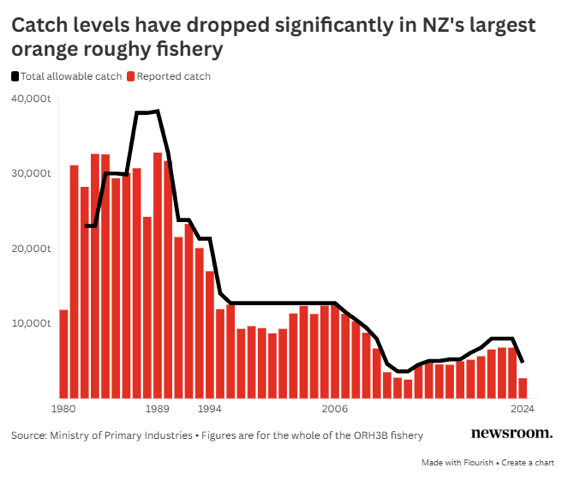
Despite claims by current Fisheries Minister Shane Jones, the Ministry of Fisheries, the fishing industry and Seafood New Zealand that the Quota Management System works, the graph showing commercial catches from 1980 – 2024 shows a steady collapsing decline to collapse and the inability of the ministry to step in and manage.
The Environmental Law Initiative (ELI) is taking legal action against the New Zealand Minister of Oceans and Fisheries Shane Jones over the mismanagement of orange roughy fisheries.
Greenpeace are angry.
“This data is consistent with what environmentalists have been saying for years – that bottom trawling has pushed this species to the brink,” said Greenpeace Aotearoa spokesperson Ellie Hooper. “It’s clear that this fishery needs to be closed, and that key spawning habitats – seamounts and features – need to be protected from bottom trawling for sustainable fish populations.”
“Newsroom” business journalist Andrew Bevin wrote “It looks like the New Zealand Government has let orange roughy get to the brink of extinction, once again, and that’s insane because we have been through this before.”
Exactly.
How incredible that public servants could be so dereliction of duty as regards the orange roughy mismanagement.
I see “Dereliction of duty is a serious offence in both employment law and military contexts, often leading to severe disciplinary action, including court-martial for service members.”
How is it then that public servants can be so incompetent and apparently not accountable?
This is sadly by no means uncommon. The seeming sheer incompetence of so many ministers may be in part due to pressure on them by powerful in interest groups lobbying them. Whatever…but this orange roughy situation is an absolute disgrace.
The Quota Management System is badly flawed:-
Environmental Degradation: The focus on maximising economic yield can lead to the exploitation of marine ecosystems, reduced biodiversity, and overfishing of certain stocks, e.g. this case of orange roughy.
Fish Dumping and High-Grading: To avoid penalties for exceeding strict quotas for specific species, fishermen often dump perfectly good fish back into the ocean, resulting in unnecessary waste.
Corporate Monopoly: The system can lead to monopolies where a small number of entities hold the majority of the quota, allowing them to buy-out smaller Kiwi operators, aggregating quota to increase the corporate monopoly.
Neglect of non-Commercial Interests like recreational and indigenous (Iwi) access to fisheries, impacting badly on cultural and recreational fishing.
In this case of the orange roughy collapses clearly it does not work especially so because of incompetent inefficient management from the ministry and a succession of incompetent ministers lacking in interest, knowledge and commonsense.
So bureaucrats and the corporates rule and ignore the public interest.
When similar outcomes occur across decades, it raises questions about whether the system is responding effectively to known risks.
How could the Ministry not learn?
How could politicians not learn?
It needs searching scrutiny.
The New Zealand Quota Management System (QMS), once lauded as a world-leading sustainability model, is now facing intense criticism, with claims that it has become a “dead loss” or “failing” system. It has failed to achieve its goals of sustainability and economic efficiency.
Credible, independent enquiry needed into the orange roughy collapses and the ability/inability of the ministry to implement sensible sustainable fishing which after all is a prime goal of the Fisheries Act.
Accountability is the name of the game.
Tony’s contribution highlights the importance of recognising long-term signals, particularly where past experience appears consistent with current observations.
Repeated pressure on the same stock over time suggests that outcomes are not always being matched to the available knowledge.
Species with slow growth and late maturity present well-known management challenges. Aligning harvest levels with those biological realities remains critical.
Sadly you were right again about the routine abuse of our natural resources by vested interests and asleep-at-the-wheel Ministers.
The pattern described is not new. Similar concerns were raised during earlier phases of the fishery, and the recurrence of those issues warrants attention.
Usually attributed to Einstein, but more likely Rita Mae Brown, the line “Insanity is doing the same thing over and over again and expecting different results,” applies Oh so well here – unless you are going to seriously review management of stocks then of course you will get the same insane results.
Whenever I see further examples of the startling stupidity of politicians I’m reminded of a quote from a character in one of T. H. White’s novels;
“…….if doctors had to pass examinations before they could cut out his appendix, then members of Parliament ought to pass examinations before they could rule his life”.”
I chanced to see minister oif Oceans and Fisheries Shane Jones talking of the Quota Management System (QMS) as being a “property rights-based quota system.”
He’s got it wrong.
It’s not a property right.
It is a privilege for commercial fishers to be given the right to fish, but it is NOT a property right. The fishery is a resource which belongs to the public.
So Mr. Jones and your corporate bed-fellows, hands off the public’s fishery, respect the privilege by being sustainable and not plundering.
Arthur Lewis, you are correct.
The fundamental idea behind the QMS is that commercial fishers own (or lease) the right – not ownership of the fish stocks – to catch a certain proportion (quota) of the Total Allowable Catch (TAC) of a certain species of fish. These quotas can be freely traded. Market forces are assumed to achieve economically optimal outcomes.
But they don’t.
The QMS has become dominated by corporates whose first and foremost aim is to maximise profits. The domination/monopoly is that just five large companies own over 80 per cent of quota. Sixty (60) per cent of the offshore catch is taken by foreign charter vessels (FCVs) under contract to New Zealand fishing companies.
But the quota system, as flawed as it is fundamentally, is further flawed by human nature of power and greed.
Corporate companies donate to political parties to “buy” favour. They exert powerful influence on politicians and ministry bureaucrats in order to get special privileges and thus maximise profits.
“Follow the money trail,”: as a friend puts it..
Yes it is not a property right for commercial fishing interests.
People wrongly call public wilderness lands, DoC land. It is not DoC land, it is public land.
The fishery is a public resource as Arthur Lewis says. The onus by the Fisheries Act is for the public resource to be managed in the public interest, not in the moneyed interests of the “fat cat” companies or any commercial interest.
The orange roughy dual plunderings, three decades or so apart, show the ministry is in the “slow learner” class and frankly inept. How could the same colossal blunder be made again?
Agree. The ministry and QMS needs to be investigated by a public enquiry. Not a “whitewash” either.
Perhaps their path to extinction is what NZ Fisheries, …. oops NZ First, mean by fast track!
The clowns dont learn from past examples do they?
Shane Jones has believes that he is not accountable to anyone, and has proved multiple times the he is a blundering arrogant imbecile that has no regard for the future sustainability of our Fishery’s
Would be great if the ELI were successful in there case against Jones.