
An Analysis of Shane Jones and Fisheries
A very personal opinion by Andi Cockroft, Chair, CORANZ.
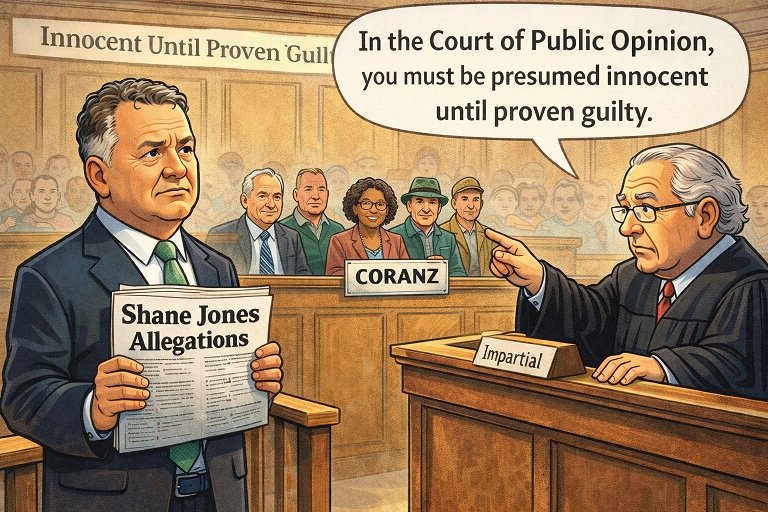
(Please note this is a personal opinion piece and does not reflect any CORANZ specific policy implied or otherwise. I believe we should always afford the benefit of the doubt and not accept allegations of wrong doing through either printed or social media without foundation evidence.)
Recently, there has been rumours in New Zealand suggesting that Fisheries Minister Shane Jones is somehow “in the pocket of” the commercial fishing industry. The claim still circulates seemingly without question - in conversations, online forums, and social media.
It is understandable why such suspicions arise. Fisheries management is contentious. Commercial and recreational interests frequently collide. Decisions are rarely neutral in their effects. When policy outcomes appear to favour one group over another, people look for explanations - and personal motives are often the easiest place to land.
But suspicion is not evidence. And in a democracy that depends on trust, even uncomfortable truths need to be separated from assumptions.
This piece does not seek to defend Shane Jones’s policies, nor to endorse his approach to fisheries management. Policy decisions should always be open to criticism. Instead, it seeks to address a narrower and more important question:
Is there any actual evidence that Shane Jones has been improperly influenced by, paid by, or financially tied to the commercial fishing industry?
At present, the answer is no.
What the Public Record Actually Shows
New Zealand has relatively strong transparency requirements around political funding, ministerial conduct, and conflicts of interest. Ministers are required to disclose financial interests. Political donations are regulated and reported. Cabinet ministers are bound by the Cabinet Manual, which requires recusal where conflicts arise.
To date, there is no public record showing that Shane Jones:
- has received illegal or undeclared donations from commercial fishing companies
- holds personal shares or financial interests in fishing companies
- receives personal payments or benefits from the commercial fishing sector
- has been investigated or sanctioned for corruption related to fisheries
That absence of evidence matters.
If such proof existed - documents, donation trails, undeclared interests, whistleblower testimony - it would already be front-page news. New Zealand’s political culture is not shy about exposing wrongdoing, and fisheries is too high-profile a portfolio for serious misconduct to remain hidden.
Yes, He Has Fisheries Background - But Context Matters
It is also true that Shane Jones has a history in fisheries governance. Before entering Parliament, he held senior roles connected to Māori fisheries settlement structures, including leadership positions associated with Sealord and the Treaty of Waitangi Fisheries Commission.
Those roles are often cited as proof of undue closeness to industry. But context matters.
These were pre-parliamentary roles, tied to the governance of iwi-owned settlement assets arising from Treaty processes. They were not secret appointments, not private directorships taken while in office, and not roles hidden from public view. They were well known, openly declared, and formed part of his professional background long before he became a minister.
One can legitimately argue that such a background shapes a person’s worldview. That is fair. But that is not the same as being “in the pay of” an industry.
Many ministers arrive in office with deep experience in the sectors they oversee: former farmers as agriculture ministers, former lawyers as justice ministers, former union officials as labour ministers. Experience can inform policy - for better or worse - without implying corruption.
Policy Bias Is Not the Same as Corruption
A crucial distinction is often lost in heated debate: the difference between policy bias and improper influence.
A minister may genuinely believe that a commercially strong fishing industry is essential for regional employment, exports, and economic resilience. Another minister might prioritise conservation outcomes or recreational access more heavily. Both positions are political judgements. Neither is automatically corrupt.
Critics are entitled to argue that Jones’s decisions place too much weight on commercial interests, or that recreational and ecological values are insufficiently protected. Those arguments should be made forcefully and publicly. But they remain policy critiques, not evidence of personal misconduct.
The danger arises when frustration with outcomes morphs into claims about motives - especially claims that imply bribery or personal gain without proof.
Why These Rumours Gain Traction
It is worth asking why the idea persists, even without evidence.
Part of the answer lies in structural imbalance. Commercial fishing interests are organised, well-resourced, and professionally represented. Recreational fishers and environmental groups often feel outmatched. When decisions go against them, it can feel as though the system itself is rigged.
There is also a long history of mistrust between communities and institutions responsible for fisheries management. Past failures - overfishing, weak enforcement, stock collapses - have eroded confidence. In that climate, people are primed to believe the worst.
Finally, Shane Jones is a blunt, unapologetic communicator. He does not soften his rhetoric. That style appeals to some and alienates others. It can easily be interpreted as arrogance or indifference, even when it reflects conviction rather than conspiracy.
None of these factors amount to evidence. But they help explain why suspicion finds fertile ground.
The Role of Donations and Lobbying
Political donations in New Zealand are regulated and disclosed through the Electoral Commission. Industries of all kinds donate to political parties. That includes agriculture, forestry, energy, unions, environmental groups, and yes, fisheries-related interests.
But donations are made to parties, not to ministers personally. They are capped, reported, and visible. A donation to a party does not establish control over a particular minister, nor does it prove a quid pro quo.
Lobbying, too, is legal and routine. Ministers meet with stakeholders across all sectors. Commercial fishers lobby. Recreational groups lobby. Environmental NGOs lobby. That is how policy is shaped.
The presence of lobbying does not, by itself, demonstrate improper influence. What matters is whether decisions are made transparently, lawfully, and with declared interests.
The Risk of Overreach
There is a real risk that unproven accusations do more harm than good.
When advocacy groups or commentators imply corruption without evidence, several things happen:
- Legitimate policy critiques are easier to dismiss as conspiracy or bad faith
- Public trust in institutions erodes further
- The debate shifts from outcomes to personalities
- Real accountability mechanisms are weakened by noise
If there are concerns about fisheries policy, they are best addressed by focusing on decisions, data, process, and outcomes - not by asserting motives that cannot be substantiated.
Ironically, exaggeration can protect those in power by allowing them to point to a lack of proof and dismiss all criticism, including the valid parts.
What Can Be Said, Fairly
It is fair to say that:
- Shane Jones has a background in fisheries governance
- His policy positions are often welcomed by commercial interests
- Recreational and environmental groups frequently feel marginalised
- Fisheries management remains deeply contested
Is it fair to say - without evidence - that he is corrupt, bribed, or secretly controlled by industry? This is not about defending an individual, It is about credibility in public debate.
A Better Judgemental Standard
If New Zealand wants better outcomes for recreational fisheries, the conversation must stay anchored in what can be proven and improved:
- Are catch limits sustainable?
- Is enforcement effective?
- Are recreational interests properly considered?
- Is scientific advice followed or simply ignored when inconvenient?
- Are ecosystems actually recovering?
These are hard questions that deserve answers. And they require persistence, evidence, and uncomfortable scrutiny. We should not speculate about envelopes of cash or shadowy deals unless such things can be shown to definitely exist.
Fairness Cuts Both Ways
It is not only reasonable to oppose policies, it is our duty. So, yes, we can argue that a minister is wrong. Yes, we can demand better outcomes for fisheries and ecosystems, but, we must remember that fairness cuts both ways.
At present, there is no evidence that Shane Jones is personally in the pocket of the commercial fishing industry. Repeating the claim as though it were fact, without any proof, weakens rather than strengthens the case for reform.
If future evidence emerges, it should be examined seriously. Until then, perhaps we should simply give Shane Jones the benefit of the doubt.
In a New Zealand already expressing severe mistrust in institutions, the distinction matters.

Andi Cockroft, Chair, CORANZ
Get off the grass. The guy is destroying the recreational fishing out there – servicing his mates and not the public.
No smoke without fire.
Yes Steve,
No smoke without fire – or just the kindling alight !!
An RNZ article from 2020 suggests some murky dealings going on under the table
https://www.rnz.co.nz/news/in-depth/410299/concerns-over-secret-fisheries-donations-to-nz-first-foundation
If Shane Jones was to scrap the deemed values fiasco then I would 100 percent believe he has no interest or collusion to the big industries in NZ. The fact this was dreamt up over whisky n cigars in dim smoke filled rooms by Talley senior reeks of incompetence by policy writers and quivering yes ministers in the past
Good journalism Andi. You are attempting to strike a balance. It is also possible that Shane Jones is just grandstanding so that he is the one in the public eye when Winston calls it quits; or maybe even to boost his own ego. Who really knows. As with any argument we need to judge its merits in the actual evidence. Lets wait and see what comes out. This is election year and we can be sure that any “dirt” will be dug up by opponents.
Political scientist and analyst Dr Bryce Edwards is on record as saying in an article titled “Fishy Influence – How the fishing industry captured Shane Jones”
that “Fisheries Minister Shane Jones has pushed through the most significant rollback of fishing regulations in decades, and it coincides with a tidal flow of cash from fishing industry donors into his coffers. Over $100,000 in documented contributions from seafood companies and executives have flowed to Jones and his party, New Zealand First, since 2017. These donations form a clear money trail that raises a disturbing question: have political donations purchased influence over fisheries policy? Jones’ sweeping pro-industry reforms, which dramatically favour commercial fishing interests over environmental protection and public transparency, make that question unavoidable.”
Dr Edwards has omitted that Jones’ “management” favours commercial over the recreational public’s (one plus million New Zealanders) interests.
The fisheries Act reqyuires the Minister to give equal consideration to the three sectors-commercial, recreational and customary. Under Jones the dice is heavily loaded in favour of the commercial corporates.
I’m for well-reasoned debate based on the facts and legitimate inferences. Sometimes those facts must be dug up by an investigative journalist.
I see no difference in Jones’s direction doling out mass benefits to commercial fishing and the rest of the coalition’s general direction of “Industry First, Public Interest Second”. Including the RMA reforms and especially their Fast-Track Approvals Act.
All of these pushing the same thing – financial benefits and to hell with the consequences methodology.
Andi, I suspect there is far more heading our way that will benefit those making the largest donations – the new section in the proposed RMA replacement legislation including Roads of National Significance (RoNS) and Proposals of National Significance (NSPs). Not to mention the ongoing ecocide going on with mass poisoning and continued support of Predator-Free.
Who benefits? Not CORANZ members, that’s for sure
I think what’s coming through in many of these comments isn’t really about allegations of corruption, but about frustration with outcomes. When policy decisions consistently appear to favour commercial interests over recreational, environmental, or public values, people naturally look for explanations - even where there’s no proof of wrongdoing. That doesn’t mean concerns are illegitimate; it means they’re being expressed through suspicion rather than through the harder conversation about policy settings, accountability, and balance. We can be critical of decisions and direction without assuming motive. Focusing on outcomes, evidence, and long-term public interest is probably where the strongest case lies.
Fair call Andi.
I think this is a thoughtful and accurate article.
Too frequently there appear anti-SJ comments that are unsubstantiated.
Those who care very deeply about fishing and the environment tend to look for the negative rather than perceive the positive, which reflects prejudice.
So often when, what the individual wants – and expects to happen- does not, then disappointment breeds resentment.
John Gornall.