
From Facebook
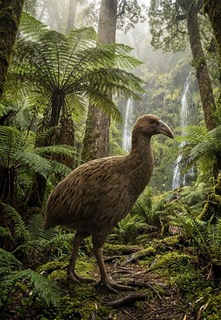
Long before humans set foot in the wild landscapes of New Zealand, the forests echoed with the presence of a strange and powerful bird-the Adzebill. With its heavy body, strong legs, and a thick, crushing beak, the Adzebill was unlike any bird alive today. It ruled the forest floor, likely feeding on insects, small animals, and even carrion. But despite its strength and uniqueness, this mysterious bird disappeared forever. So, what caused its extinction?
The main reason traces back to the arrival of humans, specifically the ancestors of the Māori people, around the 13th century.
Before humans arrived, New Zealand had no land mammals except bats. Birds like the Adzebill evolved without fear of predators. They didn’t need to fly, hide, or escape quickly. This made them incredibly vulnerable when humans entered their world.
Easy Hunting
Early settlers hunted large, flightless birds for food, and the Adzebill became an easy target. Unlike fast or flying birds, it couldn’t escape quickly. Its size and ground-dwelling lifestyle made it highly visible and accessible. Overhunting likely played a major role in rapidly reducing its population.
But hunting wasn’t the only threat. Humans also brought new animals with them-especially the Polynesian Rat (kiore) and dogs. These animals had a devastating impact on native wildlife. The Adzebill probably nested on the ground, laying eggs that were unprotected from these new predators. Rats could easily eat eggs or chicks, while dogs could hunt adult birds. This combination made survival extremely difficult.
Habitat Destroyed
Another major factor was habitat destruction. Early humans used fire to clear forests for settlement and agriculture. As forests burned and landscapes changed, the Adzebill lost its natural habitat. Food sources became scarce, and nesting areas disappeared. A bird that had adapted over thousands of years suddenly found itself in a rapidly changing environment it couldn’t cope with.
Unlike some species that can adapt quickly, the Adzebill likely had a slow reproduction rate. It may have laid only a few eggs at a time, meaning population recovery was very slow. So even small losses became catastrophic over time.
Within just a few hundred years of human arrival, the Adzebill vanished completely. Its bones, discovered later by scientists, are all that remain to tell its story.
The extinction of the Adzebill is a powerful reminder of how fragile ecosystems can be. A creature that survived for thousands of years disappeared in a blink of history due to human impact. Today, it stands as a silent warning-urging us to protect the wildlife that still exists, before more voices from nature are lost forever.
Yes – an interesting article on a little known extinct bird – it goes to show no matter the ethnic background, humans are capable of destruction. Funny(peculiar) thing, the Polynesian migrants have been lauded as conservationists. Yes true but no better or arguably no worse than other colonists.
In the craze around making NZ predator-free by 2050, the interesting aspect is the Adze bill was a predator as was the Haast Eagle preying on Moa. Would those in Predator Free NZ 2050 and other similar organisations have seen those predators as evil and invasive?
Today the native weka prey on native Paryphanta snails. Native falcon prey on small native birds.
There is all sorts of hypocrisy and double standards going on. The wacky Forest and Bird Society is crying out to get rid of deer and wapiti from Fiordland because they browse the vegetation.
However moa browsed the vegetation for millions of years before the Polynesian migrants hunted them to extinction and destroyed much necessary habitat of the flightless birds.
Question: Today, would Forest and Bird want moa got rid of, oif moa were not extinct?
I totally agree with Sandy, double standards when our environment is at stake, is simply, childesh and has no place in constructive conversations
New Zealand has Lost quite number of Native Birds like the Adze Bill & Nine Species of Moa, plus many more & sadly It’s still going on today, with what’s left of our unique Birds , due to Mans Folly ! We must stop the sad decline of what’s left of our Native Birds , by implementing an ” Incentive Scheme ” ? a modern method of Pest Control starting with STOATS , where the pay goes UP, as their numbers DROP, to keep the Trappers “KEEN ” Crowd or Lotto funded . Staring on all NON D.O.C Estate ASAP ! as 2059 > Pest Free is a Politicians Dream , as we will loose many MORE of our Native Bird Species by then , we need a “BIG Finger Pull” thus saving our best Tourist Asset ? Of note had some U.S. Guys ask me where were all the Kiwi Birds ? as they had not spotted any in the Wild , took them to see the next best thing > Weka ? they were over the bloody Moon.