
By Andi Cockroft, Chair, CORANZ
(Prompted by this article from the UK here, I looked at the available evidence to suggest measured IQ of Gen-Z in many OECD Countries had stalled or even declined).
For much of the last century, each generation grew up assuming it would be better equipped than the one before it - better educated, more capable, more adaptable. That assumption is now being quietly questioned.
Across several developed countries, long-term data shows a flattening - and in some cases a decline - in skills related to attention, problem-solving, reading comprehension and memory. The causes are debated, but one factor keeps reappearing: the way learning and everyday experience have become increasingly mediated by screens.
This is not a nostalgic argument, nor a rejection of technology. It is an observation about how humans actually learn - and what happens when lived experience is replaced by abstraction.
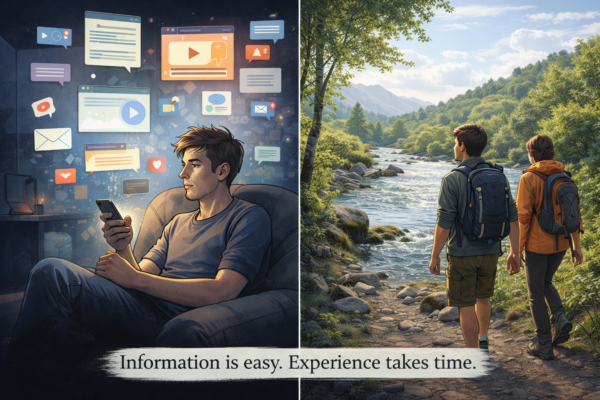
Learning is not information
Humans do not learn primarily by absorbing information. We learn by doing, failing, adjusting, and trying again. We learn through effort, feedback, and consequence.
Screens are exceptionally good at delivering information. They are far less effective at building judgement, confidence, or competence.
Outdoor activity sits at the opposite end of that spectrum.
You cannot skim a river crossing.
You cannot multitask your way through a changing tide.
You cannot fast-forward a weather front.
Outdoors, attention matters. Decisions matter. Mistakes are felt, not corrected by an undo button.
The quiet erosion of confidence
One of the least discussed effects of screen-mediated living is not ignorance, but fragility - a lack of confidence in handling unfamiliar situations without guidance, prompts, or instructions.
This shows up everywhere:
- reluctance to explore unfamiliar places,
- anxiety about “doing it wrong”,
- dependence on apps to mediate even simple activities.
Outdoor recreation, by contrast, builds confidence almost accidentally. Each small success - navigating a track, lighting a fire responsibly, judging weather, reading water - reinforces a simple lesson: I can work this out.
That lesson is powerful, and increasingly rare.
Attention, patience, and depth
Modern digital environments reward speed, novelty and constant switching. Outdoor environments reward the opposite: patience, observation and persistence.
A walk is not efficient.
Fishing is not instant.
Tramping is not optimised.
Yet these activities quietly rebuild the cognitive muscles that many people now struggle with - sustained attention, delayed reward, and situational awareness.
This may help explain why people often report feeling “clear-headed” or “grounded” outdoors. It is not just relaxation. It is the brain returning to a mode it evolved for.
Social learning without performance
Much online interaction is performative. Outdoors, interaction is usually practical and cooperative.
People talk while walking, not to impress, but because they are sharing space and time. Skills are passed on informally. Learning happens without instruction manuals or assessment.
This kind of social learning is difficult to replicate digitally, yet fundamental to how humans have always learned.
Why this matters for outdoor access
If people lack confidence, patience or practical experience, they are less likely to use public land, rivers and coasts - even when access is legally protected.
This is where outdoor recreation quietly intersects with education, health and social resilience.
The outdoors does not just provide leisure. It provides practice - in judgement, responsibility, cooperation and self-trust.
Those qualities matter well beyond recreation.
A role for outdoor organisations
The challenge is not to compete with technology, but to offer what it cannot.
That means:
- lowering entry barriers,
- normalising everyday outdoor use,
- creating spaces where learning by doing is encouraged,
- and resisting the urge to over-structure experiences.
The outdoors does not need to be gamified or digitised to remain relevant. Its value lies precisely in what it resists: shortcuts.
A quiet counterbalance
If parts of modern life are encouraging shallow engagement and over-reliance on tools, the outdoors offers a quiet counterbalance - not as a cure-all, but as a place where capability is rebuilt naturally.
That is not a romantic idea. It is a practical one.
As debates continue about education, attention, and the impacts of digital life, outdoor recreation may be doing something essential without ever claiming to: helping people relearn how to pay attention, solve problems, and trust themselves in the real world.
And that may be one of its most important contributions of all.
I remember a Maori mate of mine explaining:
Pakeha Education is Taught, Maori Education is Caught!
Meaning Pakeha sit in classrooms and are lectured, Maori kids learn with their hands by doing.
Probably something to learn from that!
As someone who “taught” Outdoor Education to teenagers over a 40 year period I fully endorse the content of the article. Time after time I saw teenagers “transformed” in a positive way by attending outdoor courses and challenging themselves, as the article says, to make decisions that they cannot skim or fast forward through. Great stuff Andi.
Very interesting seeing the great benefits of actually experiencing the outdoors and what it has to offer. We are so lucky in NZ to have the outdoors on our doorstep and available freely to every NZ citizen. Would be even better for access to be improved for older and young citizens with facilities not 3 hrs in from road ends and of course more access points. We have a lovely country to explore!
Outdoors teaches appreciation of Nature, encourages confidence and self esteem, respect for others, teamwork and the list goes on.
Instead of boot camps, there needs to be more outdoor experiencesfor youth and offenders.
Outdoor is the best classroom ever!
You only have to look at results such as these from our “education” establishment to know that something serious is going on with our younger generation.
https://ctrk.klclick1.com/l/01KGJ9YFEY27J9S6T9SZ93K4XP_19
15,000 students basically illiterate is a staggering admission of failure