
Waste does not disappear.
It is treated.
It is diluted.
It is discharged.
Recent changes to wastewater standards - including greater flexibility around discharge limits and compliance timelines - have been framed as pragmatic responses to cost pressures on councils and ratepayers.
Infrastructure upgrades are expensive.
Deadlines are difficult.
Those realities are understood.
But recreational users experience the outcome at the receiving end.
Dilution Is Not Disappearance
When wastewater standards are relaxed, it does not necessarily mean untreated effluent enters rivers.
It often means:
- Higher allowable nutrient levels.
- Extended timelines for infrastructure upgrades.
- Continued discharge under interim limits.
From a regulatory perspective, this may be practical.
From an ecological perspective, cumulative loading matters.
Limits before tools.
Downstream Is Not Abstract
Anglers, swimmers, kayakers and families using rivers and estuaries do not interact with policy documents.
They interact with water clarity, algae growth, odour and fish health.
Public confidence in recreational waters depends on visible integrity.
Even small increases in nutrient load can:
- Increase algal growth.
- Reduce dissolved oxygen.
- Stress aquatic life.
- Alter invertebrate communities.
Evidence before emotion.
Cost Is Real - So Is Capacity
Councils face real financial constraints. Ratepayers face rising bills.
But rivers and estuaries have biological thresholds that do not adjust to budget cycles.
Environmental decisions outlast political terms.
Once nutrient enrichment becomes embedded in a system, recovery is slow and expensive.
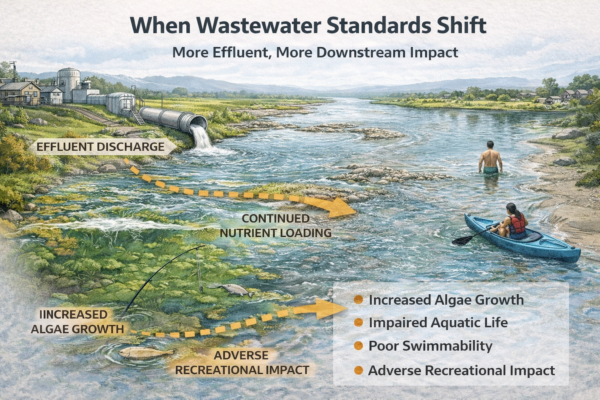
The Recreational Stake
New Zealand’s outdoor culture is built around:
- Swimmable rivers.
- Fishable estuaries.
- Safe coastal waters.
Public resource, public responsibility.
If standards shift, transparency must increase.
Recreational communities deserve:
- Clear monitoring data.
- Public reporting.
- Defined timelines for improvement.
- Assurance that interim measures do not become permanent drift.
A Simple Principle
Infrastructure pragmatism may be necessary.
But ecological limits must remain primary.
Wastewater management is not just an engineering issue.
It is a downstream issue.
And downstream is where recreation lives.
“Treatment” by most local government agencies does not usually change the chemical composition nor the bacterial content but it does visibly hide the problem …….. Success!!!
If the people downstream want clear, safe water perhaps they should clean it? Or so the clever politicians believe. Wasn’t it once stated by a former ACT leader that recreationists should pay to use rivers and lakes? That could pay for cleaning it up. Yea!