
Or: Agriculture, Nitrates, and the Public Interest
Opinion by Andi Cockroft, Chair, CORANZ
Recent opinion pieces in mainstream media have painted a confident picture of New Zealand agriculture’s future. Rising commodity prices, renewed optimism on farms, and calls for lighter regulation are presented as evidence that the sector is poised to thrive once again.
No one disputes that farming is central to New Zealand’s economy, or that farmers have endured difficult years. Economic recovery is welcome. But optimism that ignores real and growing costs - environmental, social, and health-related - is not a complete or responsible outlook.
For the Council of Outdoor Recreation Associations of New Zealand (CORANZ), the concern is not that agriculture is doing well. It is that repeated industry-led narratives about deregulation and growth continue to exclude the wider public impacts of intensive land use, particularly nitrate pollution and its consequences for land access, water quality, and human health.
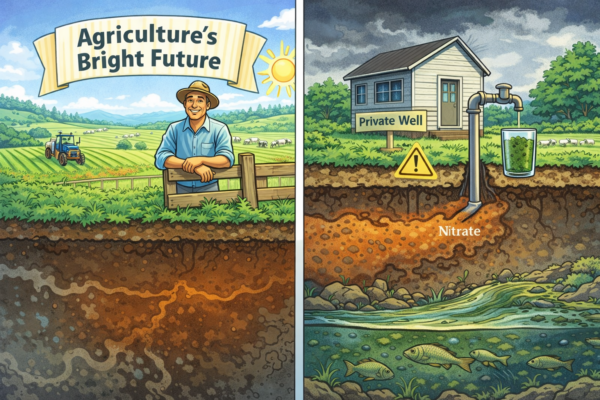
Who Is Speaking - and What Is Missing
Several recent articles promoting agricultural deregulation have been authored by senior figures within the agricultural input sector, including fertiliser companies. That is not inherently improper. Industry leaders are entitled to express their views.
However, fertiliser companies are not neutral observers in debates about nitrogen use. Nitrogen is both a key productivity input and a major pollutant. When those who profit from its sale argue for lighter regulation without addressing its downsides, readers should expect - and demand - scrutiny.
What is most striking is not the optimism expressed, but the consistent silence on nitrates.
Nitrates: The Invisible Constraint
Nitrate pollution is one of the most significant environmental challenges facing New Zealand today. It is not hypothetical, nor is it confined to academic debate.
Across large parts of the country - particularly Canterbury - nitrate levels in groundwater and waterways have risen steadily over decades, largely driven by intensified land use and nitrogen fertiliser application.
Yet in many “outlook” pieces, nitrates are not mentioned at all.
This omission matters because nitrates are not just an environmental issue. They are a public health issue, a recreational access issue, and a long-term land-use issue.
Human Health Risks Cannot Be Waved Away
The health implications of nitrate-contaminated drinking water are now well established in international research.
Elevated nitrate levels have been associated with:
- increased risk of bowel (colorectal) cancer
- potential impacts on pregnancy outcomes
- blue baby syndrome (methemoglobinemia) in infants
Importantly, emerging research suggests that health risks may occur at nitrate levels below New Zealand’s current maximum acceptable values, which were originally set to prevent acute poisoning, not long-term cancer risk.
In rural areas, many households rely on private wells that are not routinely monitored and are often vulnerable to nitrate contamination. These are not abstract risks. They affect real families, often with limited ability to switch water sources.
When agricultural outlook articles talk about “opportunity” and “momentum” without acknowledging these risks, they are omitting a critical part of the public interest.
The Canterbury Context Cannot Be Ignored
Canterbury provides a clear example of why omission is problematic.
The region has experienced:
- widespread nitrate contamination of groundwater
- declining freshwater ecosystems
- growing concern over drinking water safety
- a formally declared nitrate emergency
This is not a fringe issue. It is a defining challenge for land use in the region.
Yet some industry commentary manages to discuss the future of agriculture without mentioning Canterbury’s nitrate emergency at all. That silence is not neutral. It frames regulation as unnecessary constraint rather than a response to real harm.
Environmental Degradation and Access Loss Go Hand in Hand
From a CORANZ perspective, nitrate pollution is not just about water chemistry. It is about what happens to land and water when intensification proceeds without effective limits.
As water quality declines:
- rivers become less attractive for recreation
- public swimming holes are avoided
- fishing opportunities decline
- access is restricted for safety or liability reasons
Over time, degraded environments lead to reduced public presence. Reduced public presence makes it easier for landowners - especially absentee or overseas owners - to close access altogether.
Environmental decline and access loss reinforce each other.
Deregulation Without Accountability
Industry calls for deregulation often use language like “certainty”, “competitiveness”, and “backing our winners”. These sound reasonable, but they avoid a fundamental question:
Certainty for whom - and at whose cost?
Regulation exists because past permissive systems failed to protect water, ecosystems, and public health. To advocate for deregulation without explaining how nitrate pollution will be prevented or reversed is to ask the public to accept risk without safeguards.
CORANZ does not argue that farming should be shut down or vilified. But it does argue that land use must operate within ecological and health limits, not push those limits aside in the name of short-term economic gain.
Bias by Omission Is Still Bias
It is important to be precise. Many of these opinion pieces do not contain factual errors. The problem is selective storytelling.
By highlighting economic positives and excluding environmental and health costs, they:
- present agriculture as a net public good without trade-offs
- frame regulation as obstruction rather than protection
- marginalise communities affected by pollution
- normalise continued intensification
This is bias by omission - and its effect on public understanding is significant.
Why This Matters for Outdoor Recreation
CORANZ represents people who value land and water for recreation, connection, and wellbeing. Clean rivers, safe water, and open access are not luxuries; they are foundational to outdoor recreation.
Health risks from nitrates also affect how and where people recreate:
- families avoid rivers perceived as polluted
- communities lose confidence in local water sources
- access becomes constrained by environmental decline
Outdoor recreation depends on trust - trust that water is safe, land is healthy, and access is legitimate. Nitrate pollution erodes that trust.
A Call for Honest Accounting
A credible discussion about the future of agriculture must include:
- acknowledgement of nitrate pollution
- recognition of human health risks
- acceptance of ecological limits
- transparency about trade-offs
Optimism is welcome, but it must be honest. Growth that shifts costs onto rivers, communities, and future generations is not sustainable, no matter how positive the balance sheet looks today.
Where CORANZ Stands
CORANZ’s position is consistent and long-held:
- Land use must respect environmental and health limits
- Access and recreation are legitimate public interests
- Pollution that degrades land and water undermines access
- Regulation exists to protect the commons, not to punish industry
Calling out biased narratives is not anti-farming. It is pro-accountability.
Conclusion: A Future Worth Defending
New Zealand agriculture can have a strong future. But that future cannot be built on selective storytelling.
Ignoring nitrates does not make them disappear. Ignoring health risks does not protect communities. Ignoring access loss does not preserve recreation.
If agriculture is to thrive in a way that retains public trust, it must confront its impacts honestly and work within limits that protect people, land, and water.
CORANZ will continue to advocate for that balance - because outdoor recreation, public health, and environmental integrity are not optional extras. They are part of the national interest.
Well said and well defined – now let’s have a plan to mitigate the risks and some action to make it happen.
You really have to question the priorities of the media. Is it just plain incompetence? Or ignorance? Or lack of credibility? The niutrate issue is both an environmental and health issue. The Danish study of 2.7 million people over several years on nitrates in drinking water showed a strong link to bowel cancer.
The newspapers (Stuff) are well aware of the issue. In 2019 “The Press” reported “Users of Canterbury’s world-renowned drinking water have been issued a dire warning: “Pollution could render it undrinkable in 100 years.”
The warning comes from the Canterbury Medical Officer of Health, Dr Alistair Humphrey, as concern builds over nitrates entering the water supply from dairy farms.
In the latest publicly-funded Frank Film episode – Dairy farming and the water we drink – Humphrey warns of the risk of nitrate contamination in Christchurch’s water.”
Did you really expect anything better from a media, bought and paid for either by Government or advertising blocs such as Agriculture?
They ain’t gonna bite the hand that feeds them – bugger the consequences to the public at large.
Is there a way for CORANZ to get an article published as a counter-argument? Letters to the editor at least should be calling out the lack of balance.
Sadly even the New Zealand Media Council whilst requiring accuracy, fairness, a distinction between fact and opinion, and avoidance of misleading omissions in news reporting, it specifically excludes opinion pieces – indeed these are explicitly allowed to be one-sided!
The Council does not require “balance” in opinion columns
Editors are allowed to publish strong advocacy views
A complaint can only succeed if: material facts are wrong, or readers are misled about what is fact vs opinion
Sad state of our media.
As Andi notes, rural sector boosters call for “backing our winners”.
But you can’t have winners without losers (in the case of nitrates, it is the rest of the community).
Nitrates in the water supply are like heart disease; they are the silent killer.
As you say so well – bias by omission is still bias!!!!! I echo Charles Henry’s comments.
One point that often gets blurred in this discussion is scale and certainty. South Canterbury has, at times, recorded some of the higher bowel cancer incidence rates within New Zealand, and parts of the region also have elevated nitrate levels in groundwater used for drinking water. What is not established is direct causation - correlation is not proof. That said, international research increasingly suggests that long-term exposure to nitrates, even below current guideline limits, may carry health risks. Given this, it seems reasonable to ask whether the overlap between intensive land use, rising nitrate levels, and regional health outcomes deserves more independent investigation rather than dismissal. Asking the question isn’t accusing anyone - it’s acknowledging uncertainty and the need for precaution where public health is concerned.
Fingers should not be pointed without valid support. It is valid to criticise where situations clearly show problems. The hard thing to establish will always be a solution.
In the arena of action some people step, Shane Jones is one, and he should be commended for doing we hope his best. Everyone else is welcome to join him, and hopefully good management if our nation’s resource will benefit the citizens.