Guest Post by Dave Rhodes
Recent reporting on the spread of parchment worm in the Marlborough Sounds raises an uncomfortable question for environmental management in New Zealand: at what point does uncertainty become an excuse for doing nothing?
The current position appears to be that meaningful intervention is difficult because the parchment worm’s origins are unclear. It is described as cryptogenic - neither definitively native nor definitively introduced. As a result, the issue is increasingly framed as falling into the “too-hard basket”.
That position deserves scrutiny.
Native status does not equal immunity from management
Even if the parchment worm were eventually proven to be native, that fact alone should not preclude intervention.
New Zealand has never treated “native” as a blanket exemption from management. When native species cause demonstrable harm in specific contexts, they are actively managed. Kererū have been translocated. Raptors are controlled at airports. Native birds are excluded from sensitive habitats when they threaten ecological balance or public safety.
In each case, the question is not origin, but impact.
If a species - native or otherwise - overwhelms ecosystems, displaces other species, and degrades environments valued by the public, then management is not heresy. It is stewardship.
Impact, not taxonomy, should guide response
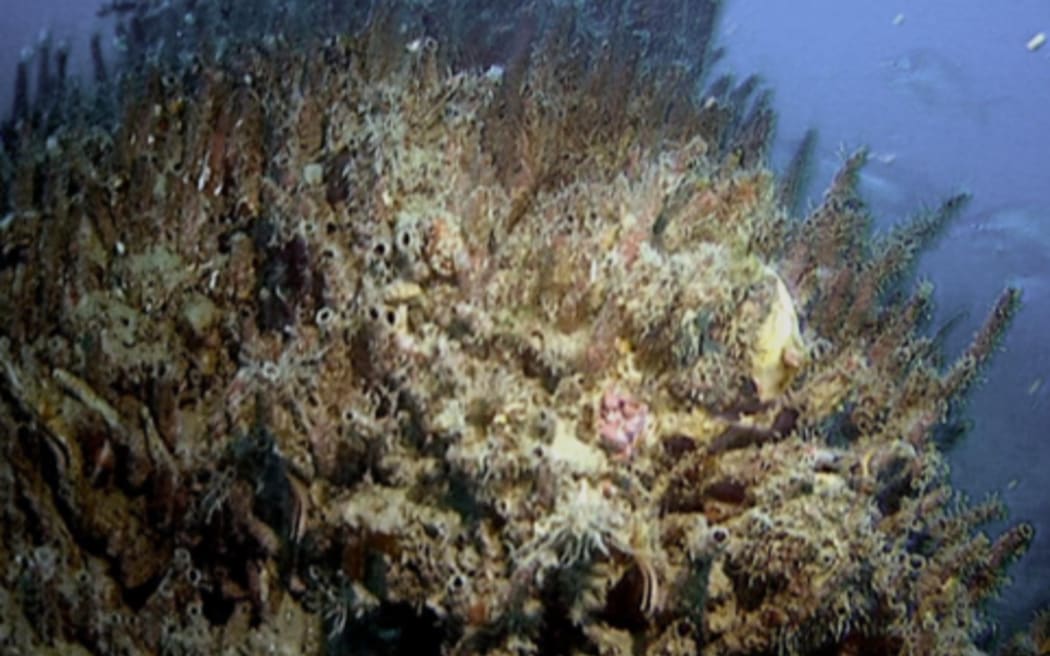
The reporting makes clear that dense worm mats are replacing native tubeworm systems and coinciding with the disappearance of species such as scallops. That represents a functional ecological shift, not a marginal change.
If the same level of impact were attributed to a native bird, fish, or plant species in a confined area, management tools would be considered. The absence of tools for worms appears to reflect a lack of preparedness, not a principled position.
Ecological harm does not become acceptable simply because it is inconvenient to address.
“We can’t control them” is not a strategy
Another recurring argument is that parchment worms cannot be effectively controlled at scale.
That may be true. But it is not a justification for inaction.
Many environmental challenges begin without obvious solutions. Control methods are developed because harm is recognised early, not because they arrive pre-packaged. Declaring a problem unmanageable before attempting management risks turning present-day impacts into permanent outcomes.
The role of public agencies is not to act only where solutions are easy, but to respond proportionately where evidence of harm exists.
The cost of delay is cumulative
The longer a problem is allowed to persist without intervention, the harder and more expensive it becomes to address. Early, imperfect action often prevents later, irreversible loss.
Communities in the Marlborough Sounds have raised concerns for years. Their frustration is not simply about worms; it is about a system that appears reluctant to act unless certainty is absolute and tools are guaranteed.
Environmental management rarely enjoys that luxury.
Why this matters for recreation and access
Healthy marine ecosystems underpin recreational fishing, diving, and general enjoyment of coastal environments. When benthic habitats are altered at scale, those values are diminished - often quietly, over time.
For CORANZ, this is not an abstract debate. It is about whether governance systems are capable of responding to emerging ecological harm before access and amenity are degraded beyond recovery.
Conclusion
Whether the parchment worm is native, introduced, or something in between should not be the decisive factor. Impact should be.
If a species is demonstrably altering ecosystems in ways that diminish biodiversity and public value, then management options must be explored - even if they are imperfect, even if they challenge established categories.
Treating uncertainty as a reason for inaction is not neutrality. It is a choice - and one that carries consequences.
Stewardship requires more than classification. It requires judgement, responsibility, and the willingness to act before problems become permanent.
Andi Cockroft, Chair, CORANZ
“We can’t control them” is not a strategy as put above, rings a bell with Marlborough where the Marlborough District Council removed Old Man’s Beard from the plant pest list because it could not control or combat its spread. Carrying on the irrational silly “strategy” is that wallabies are rated a number one pest, yet there are no wallabies in Marlborough.
So the strategy is – ignore an actual real pest while an imaginary pest is chased.
In Te Reo Maori the over riding environmental stewardship concept is Kaitiakitanga = the position of protecting or defending something.
“guardianship of traditional beliefs and standards”
= guardianship or management, especially of an environmental area or resource.
“land is considered a resource to be respected according to the principle of kaitiakitanga”
All of this requires is common sense. As Andi states: If a species - native or otherwise - overwhelms ecosystems, displaces other species, and degrades environments valued by the public, then management is not heresy. It is stewardship. DOC should be leading the charge for Kaitiakitanga/Stewardship of our current ecosystems. Delegating it out to MPI, Regional Councils, or private contactors just avoids dealing with it.